A Dallas car lockout call goes more smoothly when dispatch gets precise details. Share the vehicle’s year, make, model, exact location, access conditions, and where the keys appear to be. Quick Tow Dallas then refers the request to a licensed, insured operator who can confirm whether lockout service is available.
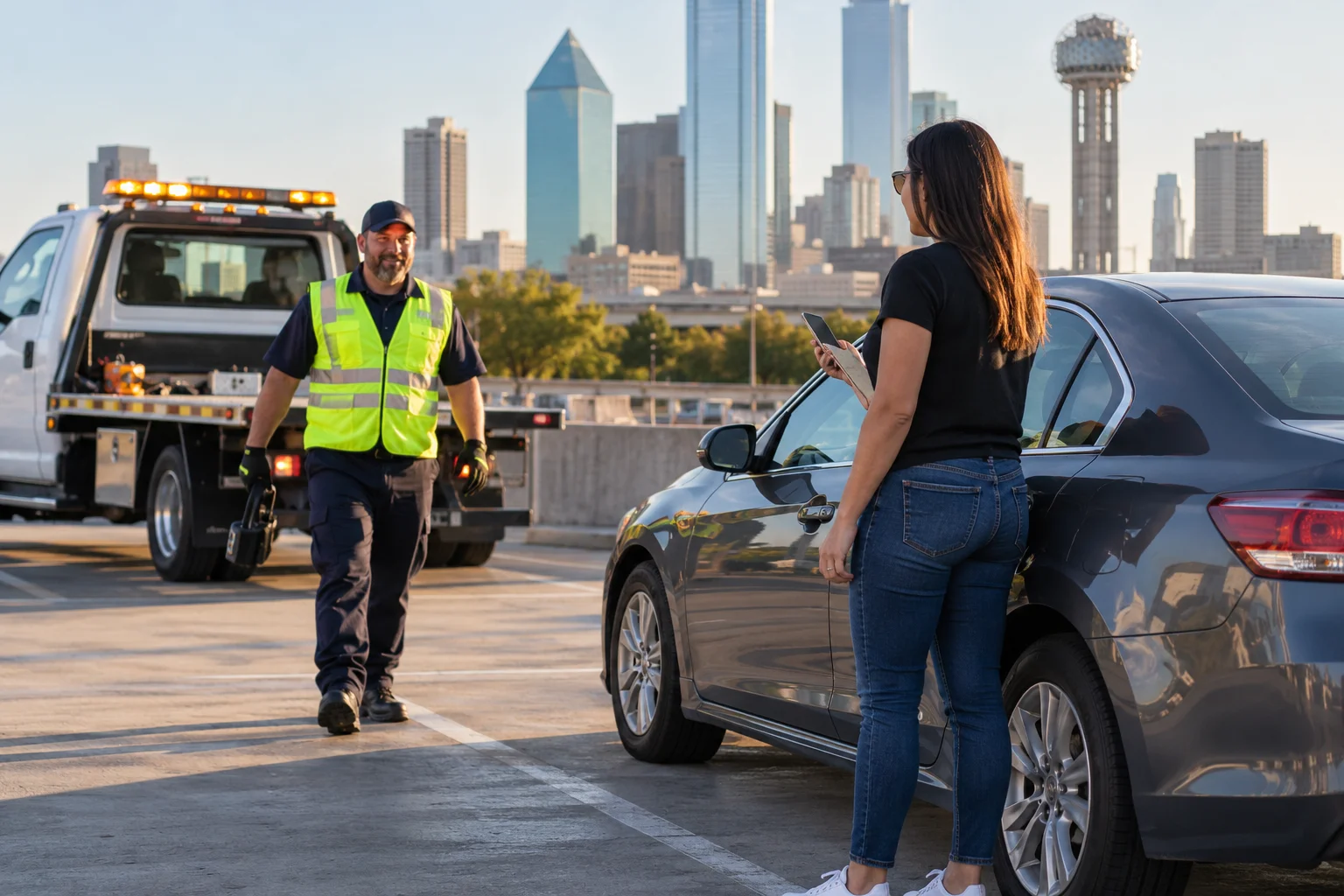
Share the exact vehicle and location
Start with the vehicle’s year, make, model, body style, and color. Include the license plate if you can read it without guessing. Those details help distinguish your car in a crowded parking area.
Your location needs more than “Downtown Dallas” or “near North Dallas.” Give the street address, garage name, business name, or nearest marked intersection. Then explain where the vehicle sits within that property.
A useful Downtown garage description might include the level, row, and nearest elevator bank. In an Oak Cliff neighborhood, name the street and closest cross street. For a North Dallas shopping center, identify the store entrance and parking-lot section.
Map pins help, but they don’t replace spoken directions. A pin can land on the building instead of the garage entrance. It can also send an operator toward a gated entrance that customers can’t use.
Tell dispatch about anything that limits access:
- A clearance bar at the garage entrance
- A locked gate or ticket-controlled entrance
- A loading dock or employee-only area
- A narrow parking aisle
- A vehicle parked against a wall
- A space below street level
- A lane exposed to moving traffic
If you’re unsure of the address, check a parking receipt or nearby sign. Don’t guess at a cross street. A wrong location can send the request into the wrong part of Dallas.
Our broader guide to roadside assistance near you in Dallas explains why the exact entrance and parking position matter. Dallas locations vary sharply, even within a small area.
Describe where the keys are without guessing
Tell dispatch what you can actually see. The keys may be on a seat, inside the trunk, in the ignition, or somewhere you can’t confirm. A key fob may also be inside while the vehicle remains locked.
Use plain descriptions:
- “I can see the keys on the front passenger seat.”
- “The fob appears to be inside the center console.”
- “The trunk closed with the keys inside.”
- “I don’t know whether the keys are inside.”
- “The key is missing, not visibly locked in the car.”
- “The key appears broken or stuck.”
These situations don’t always require the same service. A visible key inside a locked cabin is different from a lost key. A broken key, damaged lock, or unresponsive electronic fob may require a locksmith instead of roadside lockout help. Dispatch needs that distinction before routing the call.
Don’t claim the keys are inside unless you know. If the vehicle isn’t where you left it, treat that as a missing-vehicle issue rather than a lockout. Check posted parking restrictions and the property’s towing information. Our guide on how to find a towed car in Dallas covers the next steps for that separate problem.
Avoid trying entry methods from videos while the request is being assessed. Don’t insert improvised objects into the door or window. Instead, explain any attempts already made. The operator needs to know if a lock, seal, handle, or window may have been disturbed.
Also mention whether a person or animal is inside. That changes the situation from an ordinary lockout and may require emergency help instead of roadside dispatch.
Garages and traffic lanes create different access problems
A locked car in a Downtown garage presents different access conditions than one on an Oak Cliff street. The vehicle problem may be similar, but the operator’s route and working space aren’t.
Downtown garages can have clearance limits, controlled gates, one-way ramps, and weak phone reception. Give dispatch the public entrance, parking level, and payment requirements you can confirm. If building staff must admit a service vehicle, contact them before the operator arrives.
An Oak Cliff curbside location may offer open access, but parked cars can leave little working room. State whether the car is legally parked, blocking a driveway, or close to an intersection. Don’t describe a service lane as a parking lot if traffic is passing beside you.
North Dallas parking lots often cover large properties with several entrances. Name the business and the side of the building. “Near the grocery entrance facing US-75” is more useful than a store name alone. If the location is near the High Five, I-635 LBJ, or Dallas North Tollway, confirm which road you used to enter the property.
A car beside an active freeway lane is not a normal parking-lot lockout. Tell dispatch if you’re on I-35E Stemmons, I-30, US-75 Central, I-635, I-20, or another major corridor. Include your direction of travel and the last exit you passed.
If the vehicle can’t remain where it is, the request may shift from lockout help to emergency towing. The operator must decide what service fits the location and vehicle. Quick Tow Dallas doesn’t make that decision on the operator’s behalf.
Confirm that roadside help matches the situation
A car lockout near me search can bring up towing companies, roadside providers, and automotive locksmiths. They don’t all handle the same work. Not every towing operator offers vehicle-entry service, and a referral doesn’t guarantee that a specific car can be opened.
Start by describing the result you need. If the keys are visibly inside an otherwise operable vehicle, ask whether the operator handles lockouts for that vehicle. If every key is lost, say that clearly. You may need key cutting or programming, which isn’t the same as opening a locked door.
A stuck ignition key, broken key, damaged lock, or failed fob also needs a precise description. Don’t request a simple unlock if the actual problem involves creating or repairing a key. Clear details let dispatch avoid sending the wrong type of provider.
Our roadside assistance service covers referrals for common roadside needs. The operator still confirms whether the requested service matches the vehicle and circumstances.
Before accepting service, ask the operator:
- Whether lockout help is available for your year and model
- Whether your location is accessible to the service vehicle
- What proof of control or possession they’ll require
- Whether the situation needs a locksmith instead
- What the operator’s price will be
- What arrival estimate the operator can currently provide
Quick Tow Dallas doesn’t set the service price. The operator does. Confirm the amount and any relevant conditions directly before the operator rolls.
You can also check a towing operator through the TDLR license search. Quick Tow Dallas connects callers with licensed, insured operators, but the customer contracts directly with the operator performing the work.
What the operator confirms before accepting the call
The operator needs enough information to decide whether to take the request. That decision covers the vehicle, requested service, location, access, and current availability.
Expect the operator or dispatcher to confirm the year, make, and model again. They may ask whether the vehicle has unusual locks, visible damage, or an active alarm. Answer only from what you can observe. Don’t guess about systems or features you haven’t verified.
The operator also needs the exact working location. A garage level, gate code procedure, or clearance restriction can affect whether the service vehicle can reach you. If you’re at a hospital complex near Parkland, UT Southwestern, Baylor University Medical Center, Methodist Dallas, or Texas Health Presbyterian, name the correct entrance and parking area. Those campuses have multiple approaches.
Be ready to explain your connection to the vehicle. Ask the operator which identification or vehicle documents must be available. Requirements can depend on the situation, so confirm them directly instead of assuming one document will always be enough.
The price comes from the operator, not Quick Tow Dallas. Ask for the service price before dispatch. If the circumstances change after arrival, ask the operator to explain any change before approving additional work.
An arrival estimate also comes from the operator. Dallas travel conditions vary between Downtown, Oak Cliff, North Dallas, and the outer Collin or Denton County corridors. Quick Tow Dallas doesn’t promise an arrival window.
If lockout service isn’t suitable, towing may be the next option. Our guide to finding a tow truck near you in Dallas explains the location and vehicle details needed for that request. Don’t authorize a tow until the operator confirms the service, destination, and price.
When to call us
Call when your keys are locked inside and you need help finding an operator who handles car lockouts. If the vehicle instead needs licensed towing work, describe its condition and exact Dallas location. Call us at (469) 902-4411 and we’ll connect you with an operator who handles this work.