Request roadside help when your car is safely accessible and has a usable spare. If the wheel looks damaged, the spare is missing, or the location is unsafe, the dispatched operator must assess whether you need towing instead. That decision matters on a Dallas freeway shoulder and in a neighborhood parking lot.
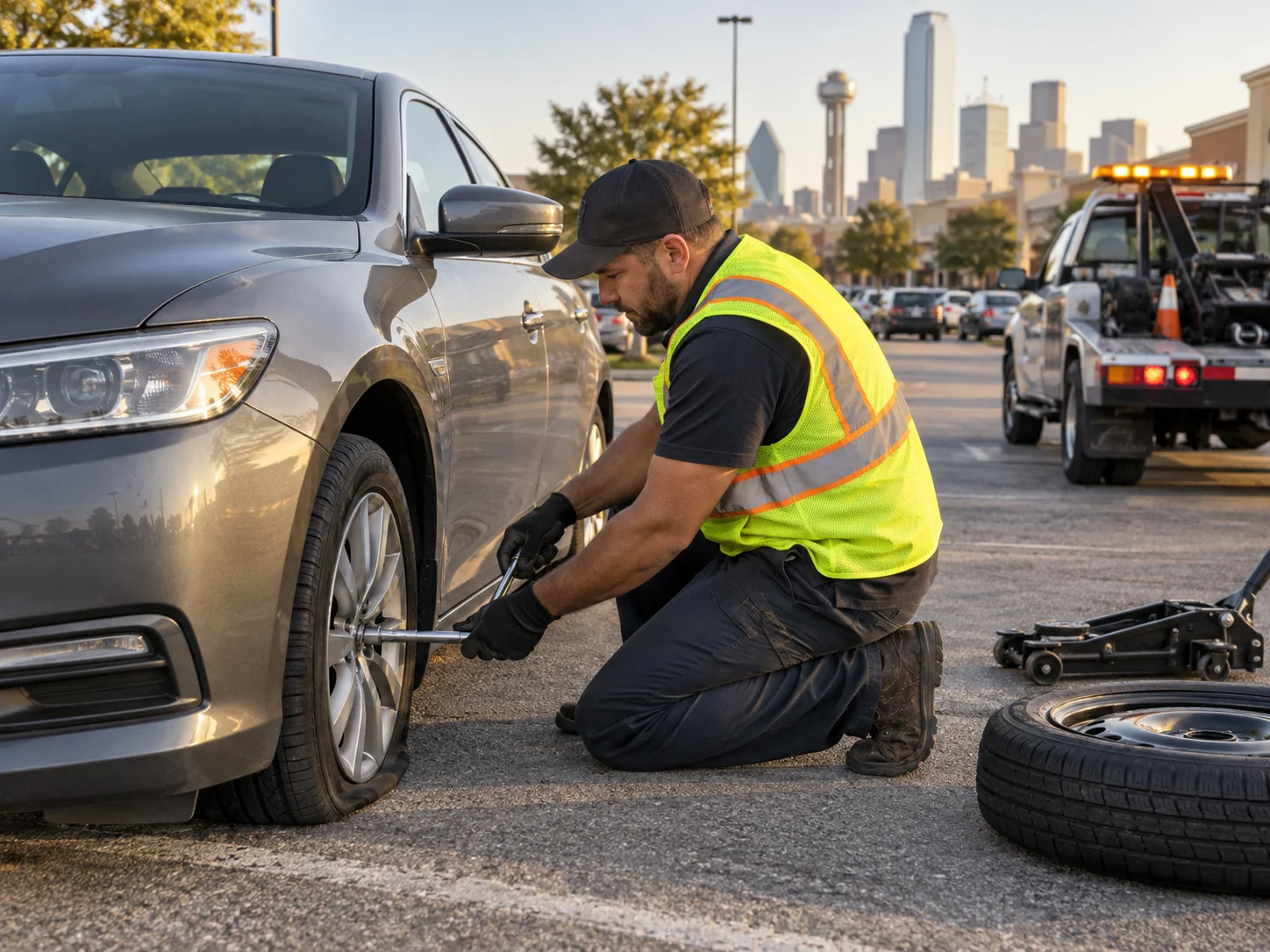
Get away from moving traffic before making the call
Your location changes the entire roadside request. A flat tire inside a retail lot offers different access than one beside I-35E. Before arranging service, focus on getting yourself away from moving traffic when you can do so safely.
Don’t keep driving simply to reach a preferred repair shop. If the car is already stopped, avoid moving it unless you can safely reach a better location. A tire, wheel, or steering problem can make further movement uncertain. An operator can help determine the next step.
Tell dispatch whether you’re in a travel lane, on a shoulder, or inside a parking lot. Mention nearby traffic and whether the damaged tire faces the roadway. If there’s an immediate danger, contact emergency services before arranging roadside work.
Dallas location details should be specific. A street address works well in Oak Cliff, East Dallas, or Lake Highlands. On a freeway, share the route, direction, nearest exit, and a visible landmark. “I-635 eastbound near the High Five” is more useful than “somewhere in North Dallas.”
Drop a location pin if your phone allows it. Also describe the car’s color, make, and model. Those details help the dispatched operator find the correct vehicle.
Quick Tow Dallas is a referral and dispatch service. We don’t operate the truck or perform the tire change. Our role is to connect you with a licensed, insured operator. You can also review our Dallas roadside assistance service before calling.
Tell dispatch whether you have a usable spare
A spare tire is often the first dividing line between roadside help and towing. Tell dispatch whether you have one, where it’s stored, and whether you can access it. Don’t assume every vehicle includes a spare.
Some cars carry a temporary spare. Others may have a different factory setup. If you aren’t sure what’s in the vehicle, say that plainly. The operator can confirm what service may be possible after reviewing the situation.
Report anything unusual about the spare. Mention visible damage, low pressure, or missing parts. Don’t describe it as usable when you haven’t checked it. Dispatch needs an accurate picture, not a confident guess.
The operator may also ask for the damaged tire’s position. “Front passenger side” is clearer than “the right one.” If your car is parked close to a curb, wall, or another vehicle, explain how much access surrounds that wheel.
Also share whether the trunk or cargo area is packed. The spare and related equipment may sit beneath stored items. If you can safely clear access before the operator arrives, that can make the handoff simpler. Don’t unload belongings beside moving traffic.
Searching for “tire repair roadside assistance near me” may bring up tire shops, roadside providers, and towing companies. Those aren’t always the same service. Quick Tow Dallas connects callers with towing operators who can assess the request. We don’t promise that every operator performs tire repairs or carries a particular tool, tire, or replacement part.
If you don’t have a membership plan, our guide to roadside assistance without AAA in Dallas explains what information to gather before dispatch.
When roadside tire help may be suitable
Roadside tire help may fit when the car is safely accessible, a usable spare is available, and the wheel has no obvious damage. The dispatched operator still makes the final assessment. Conditions at the vehicle can change what’s practical.
A parking lot, driveway, or quiet neighborhood street may offer clearer access than a freeway shoulder. Examples include a retail lot near Northwest Highway or a residential street in Pleasant Grove. Access still depends on the exact parking position, surrounding traffic, and the vehicle itself.
Tell dispatch what happened before the tire went flat. You may have noticed a warning light, a sudden loss of pressure, or an impact with road debris. Don’t try to diagnose the cause while standing near traffic. A short description gives the operator useful context.
Roadside help doesn’t always mean repairing the damaged tire. The possible job may be installing an available spare. Whether the tire itself can be repaired is a separate decision for a qualified tire professional after inspection.
The price for the call isn’t set by Quick Tow Dallas. The operator determines the service and price. Confirm both with the operator before the truck rolls. Ask what the proposed service covers and whether the request changes if roadside work isn’t possible.
You may hear several names for the person responding. A towing operator can handle towing and may offer certain roadside services. A tire technician works on tire diagnosis, repair, and replacement. The dispatched provider should explain the work they’re prepared to perform.
Before handing over your keys, you can check a towing operator through the TDLR license search. Texas towing companies and operators are licensed through the Texas Department of Licensing and Regulation.
When wheel damage means the car needs towing
A flat tire isn’t always an isolated tire problem. An impact may also leave the wheel visibly bent, cracked, or sitting at an unusual angle. Steering or suspension damage may also be uncertain from a phone description.
Don’t ask dispatch to guarantee a roadside tire change in those cases. Explain exactly what you can see. The operator needs to assess the vehicle and decide whether it should be loaded for transport.
Towing may also make more sense when there’s no usable spare. The same applies when the spare can’t be accessed or installed at the stopped location. A damaged fastener, unclear wheel condition, or blocked working area can also change the plan.
Fluid under the vehicle, collision damage, or a wheel pushed out of position should be reported during intake. Don’t label the fluid or guess which component failed. Give the operator visible facts and let the operator determine the appropriate equipment.
If towing is required, decide where the vehicle should go before dispatch when possible. That could be a tire shop, repair facility, dealership, or another location that has agreed to receive it. Confirm that destination directly with the facility.
Our emergency towing service covers situations where roadside work isn’t suitable. If you’re comparing dispatch options, the guide to finding a tow truck near you in Dallas explains what details affect the request.
Quick Tow Dallas doesn’t own trucks, employ tow drivers, or perform vehicle repairs. We route the call to a licensed, insured towing operator. You contract directly with the operator performing the work.
Dallas routes where shoulder access changes the call
Dallas freeway corridors require precise location information. I-35E, I-635, and US 75 carry drivers through different parts of the metro. A description that fits one corridor may send an operator toward the wrong interchange.
On I-35E Stemmons, state whether you’re northbound or southbound. Name the last exit you passed or the next one you can see. Near Downtown Dallas, clarify whether you’re closer to the Mixmaster or heading toward Oak Cliff.
I-635 creates another common location problem. A driver near Garland is far from someone near Las Colinas, even though both may report being on LBJ Freeway. Give the direction of travel and nearby cross street. Mention whether you’re on the main lanes or another accessible area.
US 75 runs north from central Dallas through the High Five and toward Richardson. “Northbound near the High Five” narrows the search better than “near Central Expressway.” If you’re north of Dallas in Collin County, say so. Plano and Frisco aren’t within Dallas County.
A neighborhood street requires different details. In Oak Cliff, West Dallas, or East Dallas, provide the street address and nearest intersection. In a shopping center, name the business and the side of the lot. Large lots often have several entrances.
Don’t assume roadside work can occur at every controlled-roadway location. The operator must assess access and current conditions. If the stopped position can’t support roadside work, towing may be the available option.
Ask the operator for an arrival estimate rather than relying on a generic Dallas estimate. Traffic, distance, roadway access, and operator availability can all affect dispatch. Quick Tow Dallas doesn’t promise a response window.
When to call us
Call when you have a flat tire and need an operator to assess roadside help or towing. Wheel damage, a missing spare, collision damage, or an exposed freeway position may require a licensed towing pro.
Call us at (469) 902-4411 and we’ll connect you with an operator who handles this work.