Move your car to a safe location if that’s possible. Then tell dispatch exactly where you are, what you drive, and what happens when you try starting it. That information helps an operator decide whether jump-start assistance fits the situation.
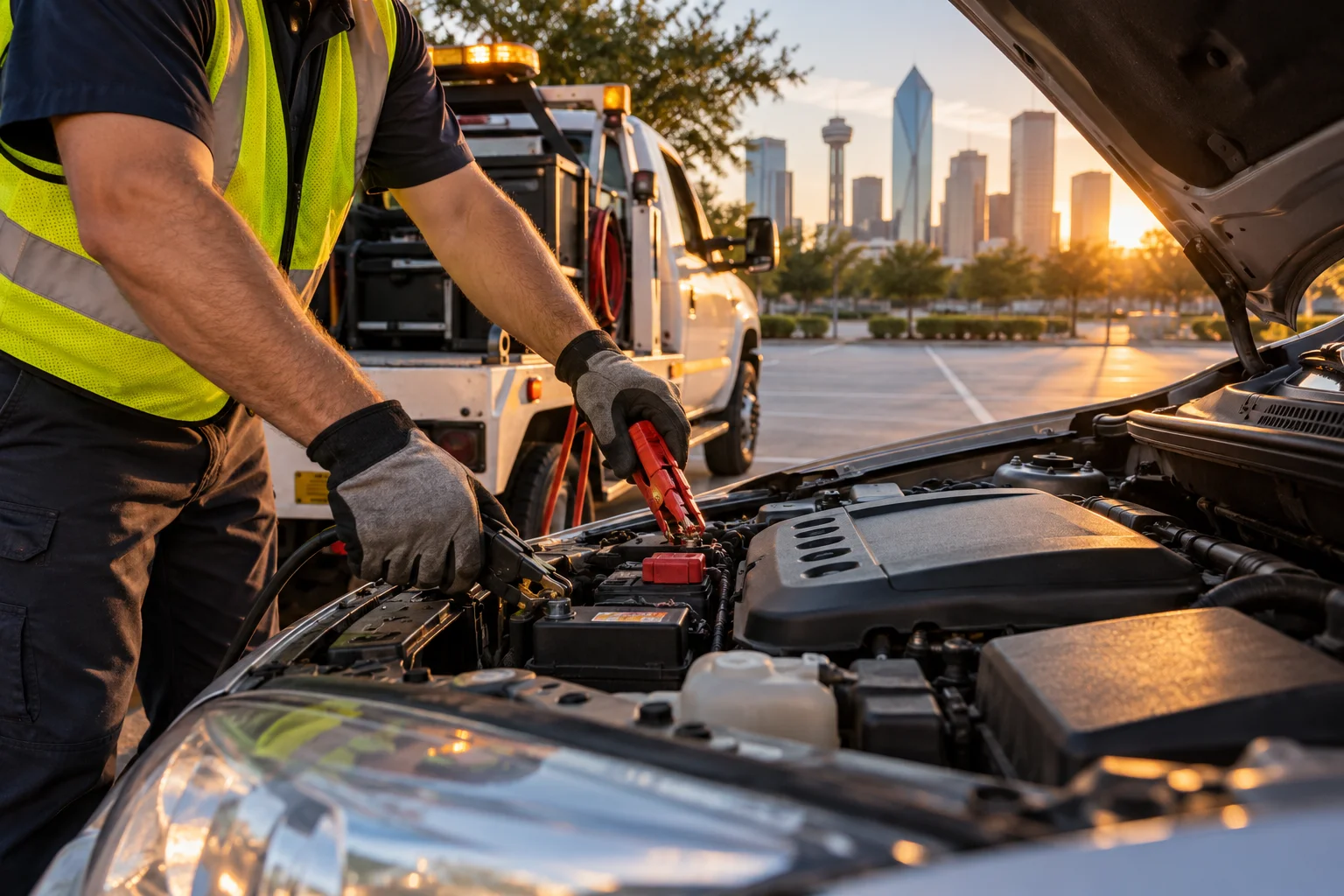
Share the vehicle, location, and battery symptoms
A search for “jump start assistance near me” usually happens under pressure. A short, specific description helps dispatch understand the request without guessing.
Start with the vehicle’s year, make, and model. Say whether it’s a car, SUV, van, or pickup. Tell dispatch whether the vehicle uses gasoline, diesel, hybrid, or electric power. Don’t assume every vehicle accepts the same roadside service.
Next, give a precise location. A street address works in a neighborhood or office lot. On a freeway, share the route, direction of travel, nearest exit, and visible landmark. “Northbound US-75 near the High Five” is more useful than “somewhere in North Dallas.”
Describe what happens when you try to start the vehicle. Useful details include:
- The dashboard stays dark
- The lights turn on, but the engine doesn’t start
- You hear clicking
- The engine turns but doesn’t start
- The vehicle started earlier, then wouldn’t restart
- A warning message appears on the dashboard
These details aren’t a diagnosis. They simply help the operator understand what equipment and service may be appropriate. Don’t take apart battery connections or attempt electrical repairs while waiting.
Quick Tow Dallas is a dispatch and referral service. We connect callers with licensed, insured operators who provide roadside assistance. The operator, not Quick Tow Dallas, decides whether the requested service fits the vehicle and situation.
Choose a safe meeting point off the traffic lane
Location affects more than navigation. It tells the operator how the vehicle can be reached and whether roadside work appears practical.
If the vehicle can be moved safely, choose a place outside an active traffic lane. A parking space, driveway, or accessible lot gives the operator a clearer meeting point. Don’t move the vehicle if doing so would place you or other drivers at greater risk.
On I-35E, I-30, I-635, US-75, or I-20, tell dispatch whether you’re on a shoulder, ramp, frontage road, or nearby lot. Include the direction you were traveling. Northbound and southbound access can place an operator on completely different approaches.
A Dallas freeway shoulder also differs from a neighborhood street. If the vehicle is exposed to moving traffic, say that immediately. Dispatch may need to discuss whether roadside assistance is suitable or whether emergency towing is the safer service request.
Share any access barrier before an operator is sent. Mention a locked gate, parking ticket system, security booth, loading dock, underground level, or restricted entrance. If someone must authorize entry, arrange that access before the operator arrives.
If there’s an immediate danger, injury, fire, or active traffic hazard, contact emergency services first. Roadside dispatch doesn’t replace police, fire, or medical help. Once the immediate danger is addressed, you can contact an operator about the disabled vehicle.
When a jump start may not solve the problem
A jump start is a service attempt, not a promise that the vehicle will run. Battery symptoms can overlap with other vehicle problems. Dispatch can collect the symptoms, but the operator must assess the service at the vehicle.
Tell dispatch if the vehicle has already received a jump attempt. Also mention smoke, unusual smells, visible damage, leaking fluid, crash damage, or dashboard warnings. Don’t ask an operator to proceed without sharing those conditions.
If the vehicle doesn’t start, the next step may be a tow. The destination could be your chosen repair facility, another approved location, or somewhere the vehicle can be inspected. Confirm the destination and service scope directly with the operator.
Drivers without a roadside membership can still request help. Our guide to roadside assistance without AAA in Dallas explains what information to gather before calling. If you have insurance, a vehicle warranty, a credit-card benefit, or another roadside plan, check its current terms directly. Coverage and payment arrangements vary, and none could be confirmed for your individual plan here.
Quick Tow Dallas doesn’t publish a jump-start price because the brand doesn’t set one. The dispatched operator sets the price. Ask the operator to confirm the service scope and price before dispatch.
A free Dallas jump-start program couldn’t be confirmed from the approved information for this page. AutoZone’s current Dallas-area policy also couldn’t be confirmed. Call the specific store or benefit provider and ask whether assistance is offered at your location before relying on it.
Dallas garages and freeway shoulders need different access
Downtown Dallas garages can create access issues that don’t exist on an open lot. Tell dispatch the garage name or street address, entrance location, floor, space number, and posted clearance. Mention tight turns, gate controls, or payment equipment. The operator must decide whether the service vehicle can enter.
If a Downtown garage won’t admit the dispatched vehicle, ask property staff where roadside providers may meet disabled drivers. Don’t assume an operator can access every underground or structured parking area.
North Dallas office lots often have several buildings and entrances. Share the company or building name only as a landmark, then give the full address and your location within the property. “The west visitor lot near the second entrance” gives dispatch a better reference than the office complex name alone.
Oak Cliff neighborhood streets require different details. Share the nearest cross street, which side of the road you’re on, and whether a driveway or parked vehicles limit access. West Dallas, Pleasant Grove, Irving, and Farmers Branch may involve different city limits and road approaches, so don’t describe every location as simply “Dallas.”
Freeway locations need route details. On the Dallas North Tollway, PGBT, or Sam Rayburn Tollway, include the direction and nearest exit. On I-35E or I-30, say whether you reached a frontage road. Never cross active lanes to meet an operator.
For broader dispatch guidance, see what to share when searching for a tow truck near you in Dallas.
What the dispatched operator confirms
Before dispatch, confirm who is providing the service. Quick Tow Dallas connects you with an operator, but the customer contracts directly with that operator.
The operator should confirm current availability, the requested service, vehicle compatibility, access conditions, and price. Ask whether the operator can enter your garage or controlled lot. If towing may become necessary, discuss the likely destination before the truck is sent.
You can also ask the operator for an arrival estimate. Traffic, distance, access, and operator availability affect timing, so Quick Tow Dallas doesn’t promise a response window.
Before handing over keys, verify the towing operator through the TDLR license search. Texas licenses towing operators and companies through the Texas Department of Licensing and Regulation. Quick Tow Dallas doesn’t hold a tow license and doesn’t perform the roadside work.
Keep these points clear during the call:
- Who is being dispatched
- What service the operator is prepared to attempt
- Whether the vehicle’s location is accessible
- What the operator will charge
- What happens if the vehicle doesn’t start
- Where the vehicle would be taken if towing is needed
If the location or symptoms change, tell the operator. A car moved from a freeway shoulder to a frontage-road lot presents a different access situation. A new warning, leak, or smell may also change the appropriate service.
Clear information protects everyone from avoidable confusion. It also lets the operator decide whether a jump-start attempt or towing request better matches the situation.
When to call us
Call when your vehicle won’t start and you need an operator to assess roadside assistance or towing. A licensed towing pro may be needed when the vehicle can’t be safely serviced where it sits. Call us at (469) 902-4411 and we’ll connect you with an operator who handles this work.