A disabled car inside a garage needs more planning than a curbside pickup. Dispatch needs the correct entrance, the vehicle’s location, and an honest description of the access before connecting you with an operator.
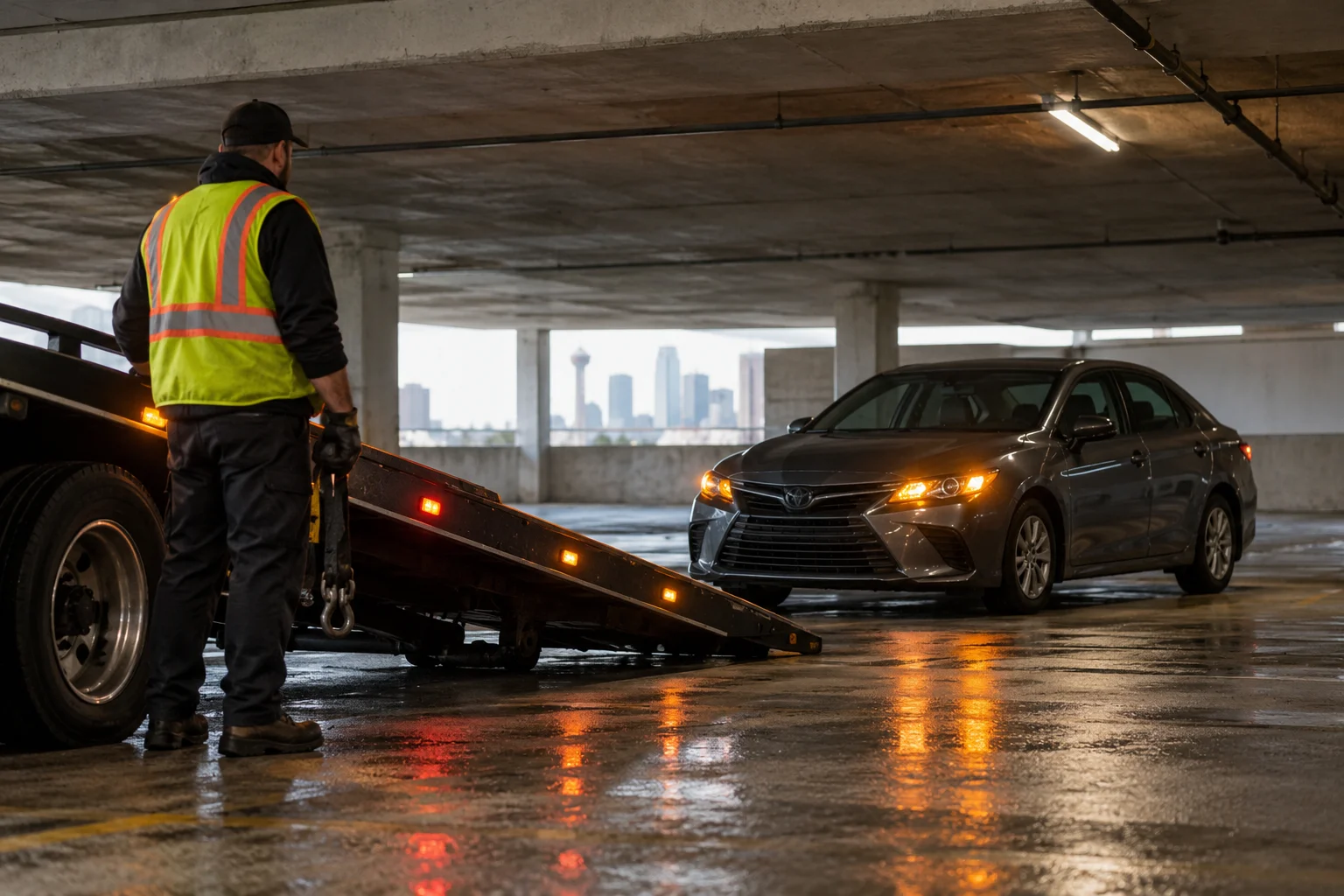
Parking garage towing in Dallas starts with information, not an equipment request. The licensed operator assesses the structure and decides what can safely reach the car. That matters in Downtown, Uptown, Oak Lawn, and North Dallas, where a street address may lead to several entrances.
Share the garage entrance and vehicle level
Start with the garage’s street address. Then explain exactly which entrance reaches your car. A building name alone may not identify the correct access point.
Downtown Dallas can make this especially important. A property may face one street while its garage entrance opens from another. Nearby routes such as I-30, I-35E Stemmons, and US-75 Central help establish the broader area, but they don’t tell an operator which driveway to use.
Give dispatch these details:
- The street used to enter the garage
- The nearest intersection
- The parking level or labeled section
- Your space number, if one is posted
- Whether the car is near a ramp, wall, gate, or elevator
- The best place for the operator to meet you
- Any entrance instructions provided by property staff
Use the garage’s own labels. Say “Level P3, blue section,” for example, if those labels appear on-site. Don’t rename a level based on how far it seems from the street. Some structures label floors differently from their connected buildings.
A dropped map pin can help identify the property. It may still point to the building’s front door instead of the vehicle entrance. Include written directions with the pin.
In Uptown or Oak Lawn, also confirm whether dispatch should use the residential, office, hotel, or public entrance. Don’t assume those entrances connect. Ask property staff when you aren’t certain.
Quick Tow Dallas is a referral service. We collect the location details and connect you with a licensed, insured towing operator. The operator then confirms the pickup point, access, service, and price before rolling.
Describe clearance, ramps, turns, and blocked access
Don’t guess the garage’s clearance. Read the posted sign at the entrance you expect the operator to use. Report its wording exactly. A photo is better when one can be taken without blocking traffic or entering a restricted area.
Clearance is only one part of access. Tell dispatch about the route between the entrance and your car. Mention sharp turns, steep ramps, narrow lanes, low overhead fixtures, gates, columns, and parked vehicles that reduce working space.
Avoid deciding that a particular tow truck will fit. Don’t compare a posted garage sign with dimensions found online. Truck configurations and towing setups differ. The operator must evaluate the entrance and the full route.
Blocked access matters too. Tell dispatch if:
- A gate won’t open
- A ticket or access card is required
- The normal entrance is closed
- A delivery vehicle blocks the lane
- Your car sits against a wall or column
- Traffic can’t pass around the disabled vehicle
- The exit route differs from the entry route
Photos can make that description clearer. Take wide images showing the car and its surroundings. Add separate views of ramps, turns, overhead signs, and gates. Don’t send only a close-up of the damaged part.
North Dallas covers a broad area around corridors such as I-635 LBJ, US-75 Central, and the Dallas North Tollway. The road used to reach the property still doesn’t describe the garage interior. Dispatch needs both pieces.
A tow truck for a parking garage may require a different setup from an open-lot pickup. That service page explains wheel-lift towing, but it isn’t a promise that this equipment will fit your garage. The operator makes that call after reviewing access.
Tell dispatch whether the vehicle rolls and steers
A car stuck in a parking garage may have a dead battery, damaged wheel, steering problem, or another mechanical failure. Describe what the vehicle does now. Don’t limit the report to what first caused the problem.
Tell dispatch whether the car rolls, steers, and shifts. Explain whether the parking brake releases. Mention a locked steering wheel, missing key, deployed airbag, damaged suspension, flat tire, or wheel that appears out of position. If you can’t confirm something, say that clearly.
Also provide the vehicle’s year, make, model, and body style. Tell dispatch whether it’s gasoline-powered, hybrid, or electric. Mention modifications or unusually low bodywork when applicable. These details help the operator assess the vehicle without treating every garage call alike.
Don’t try to move a damaged vehicle just to test it for dispatch. Report what you already know and what you can observe. The operator can determine what further assessment is needed.
The difference between wheel-lift and flatbed towing in Dallas can be useful background. Still, the comparison can’t select equipment for a specific garage. The vehicle’s condition and the structure’s access both affect that decision.
If you’re considering flatbed towing, tell dispatch why. Perhaps the vehicle has wheel damage, or another party suggested that service. Present that as information, not a final instruction. A flatbed request doesn’t establish that a flatbed can enter or work inside the structure.
Be precise about uncertainty. “The car starts but won’t shift” helps more than “it’s broken.” “I don’t know if the rear wheels roll” is also useful. It tells the operator what still needs confirmation.
Confirm property access before an operator arrives
A disabled vehicle tow and an involuntary property tow aren’t the same request. If this is your vehicle and you want it moved, tell dispatch where it should go. If you’re seeking removal of someone else’s car, identify yourself as the property owner, manager, tenant, or another party.
Quick Tow Dallas doesn’t determine whether someone has authority to remove a vehicle. The operator and property representative must address that question. We also don’t manage garage gates, keys, validation, or security access.
Before dispatch, contact the garage office, front desk, security desk, or property manager when access is controlled. Ask who can open the entrance and authorize the operator’s entry. The property’s current requirements couldn’t be confirmed from the approved sources because each location controls its own access. Check directly with the property before the operator rolls.
Confirm these practical points:
- Whether the operator may enter the garage
- Which entrance property staff will open
- Whether someone must escort the operator
- Where the operator may meet you
- Whether an exit gate needs separate access
- Who will be present with the required key or credential
Don’t promise dispatch that a gate will be open unless the property confirms it. If staff haven’t responded, say so. That gap may affect whether the operator accepts the call or requests more information.
Texas towing companies and operators are regulated by the Texas Department of Licensing and Regulation. You can check an operator’s license through TDLR before handing over your keys.
If your car is missing rather than disabled, don’t order another tow. First use the guidance for finding a towed car in Dallas. The correct next step depends on who ordered the removal and where the vehicle was stored.
Let the operator select suitable towing equipment
Garage towing is an access problem and a vehicle problem at the same time. The operator needs to consider both before selecting equipment. A request for a wheel-lift or flatbed doesn’t override what the operator observes on-site.
Drivers often associate parking garages with wheel-lift towing because space may be limited. Others request a flatbed because of the vehicle’s condition. Neither label answers every question. The operator must decide whether the proposed equipment can enter, reach the car, position safely, and complete the move.
That assessment may begin with your photos and description. It continues when the operator reviews the actual entrance and vehicle. Conditions can differ from what’s visible in one picture. Another parked car, closed gate, or inaccessible turn may change the available approach.
Our role is to pass accurate information to an operator who handles this work. Quick Tow Dallas doesn’t own wheel-lift trucks or flatbeds. It doesn’t employ the driver or choose the towing method. You contract directly with the operator performing the service.
The operator also sets the service price. Ask for the price and any conditions before the truck rolls. Don’t rely on an online estimate, a previous tow, or another garage’s price.
For more context, read when to request a flatbed tow truck in Dallas. Use it to prepare questions, not to make the operator’s equipment decision.
A clear dispatch report keeps the decision grounded in the actual job. Give the operator the entrance, posted clearance information, garage route, vehicle condition, destination, and property contact. Then let that operator confirm whether the call can be handled and what equipment is suitable.
When to call us
Call when your disabled vehicle is inside a Dallas garage and needs assessment by a licensed towing professional. Have the entrance, parking level, access details, vehicle condition, and property contact ready. Call us at (469) 902-4411 and we’ll connect you with an operator who handles this work.