A breakdown in Irving can mean a freeway shoulder or office garage. Those situations need different trucks, access plans, and pickup instructions. If you need a tow truck in Irving, your exact location matters first.
Irving and Las Colinas vs Downtown: distance and routes
Irving and Las Colinas sit west of Downtown Dallas. A dispatch there shouldn’t be treated like a Downtown pickup. The operator may approach from another part of Irving, from Dallas, or along a nearby highway corridor.
That distance affects which operator makes sense for the call. So does your destination. A short move to a repair shop in Irving differs from a tow east into Dallas. A longer trip needs a destination that can receive the vehicle when it arrives.
Tell dispatch where the car is now and where it should go. Include the street, property name, garage entrance, or closest visible marker. If you’re unsure of the address, use your phone’s map pin. Confirm the city shown in the address instead of saying only “Dallas.”
Las Colinas also has office buildings, garages, private drives, and controlled entrances. The closest operator by road may not have a clear path to your vehicle. Height limits and tight turns can affect the truck type sent.
Quick Tow Dallas serves Irving through its referral network. We answer the intake call and connect you with a licensed, insured towing operator. The operator performs the tow, sets the price, and contracts with you directly.
Before accepting a dispatch, confirm both endpoints. You should also tell the operator whether the vehicle rolls, steers, and shifts into neutral. Those details help avoid sending a truck that can’t handle the location or vehicle condition.
SH 114, SH 183, Loop 12, and the Trinity crossing
Irving’s main corridors shape nearly every roadside dispatch. SH 114 runs through Las Colinas and toward the airport area. SH 183 crosses Irving farther south. Loop 12 connects those routes with Dallas and other nearby corridors.
A breakdown on one of these roads needs precise location information. “I’m on SH 114” isn’t enough. Give the travel direction, nearest exit, and whether you’re before or after that exit. Mention whether the car is on a shoulder, ramp, frontage road, or nearby lot.
The Trinity crossing adds another routing issue between Irving and Dallas. A disabled car may look close on a map while sitting across limited road connections. Dispatch needs the actual travel route, not just straight-line distance.
Move away from traffic when you can do so safely. Stay inside the vehicle if leaving it would place you near active lanes. If there’s a crash, fire, injury, or immediate traffic danger, contact emergency services first.
For a disabled vehicle exposed to moving traffic, emergency towing may be appropriate. A dead battery or flat tire in a protected lot may instead need roadside assistance.
Don’t attempt a repair beside high-speed traffic. Tell the operator about narrow shoulders, blocked lanes, damaged wheels, or debris. The driver can then plan the safest practical loading approach after reaching the scene.
Office-garage stalls vs a roadside breakdown
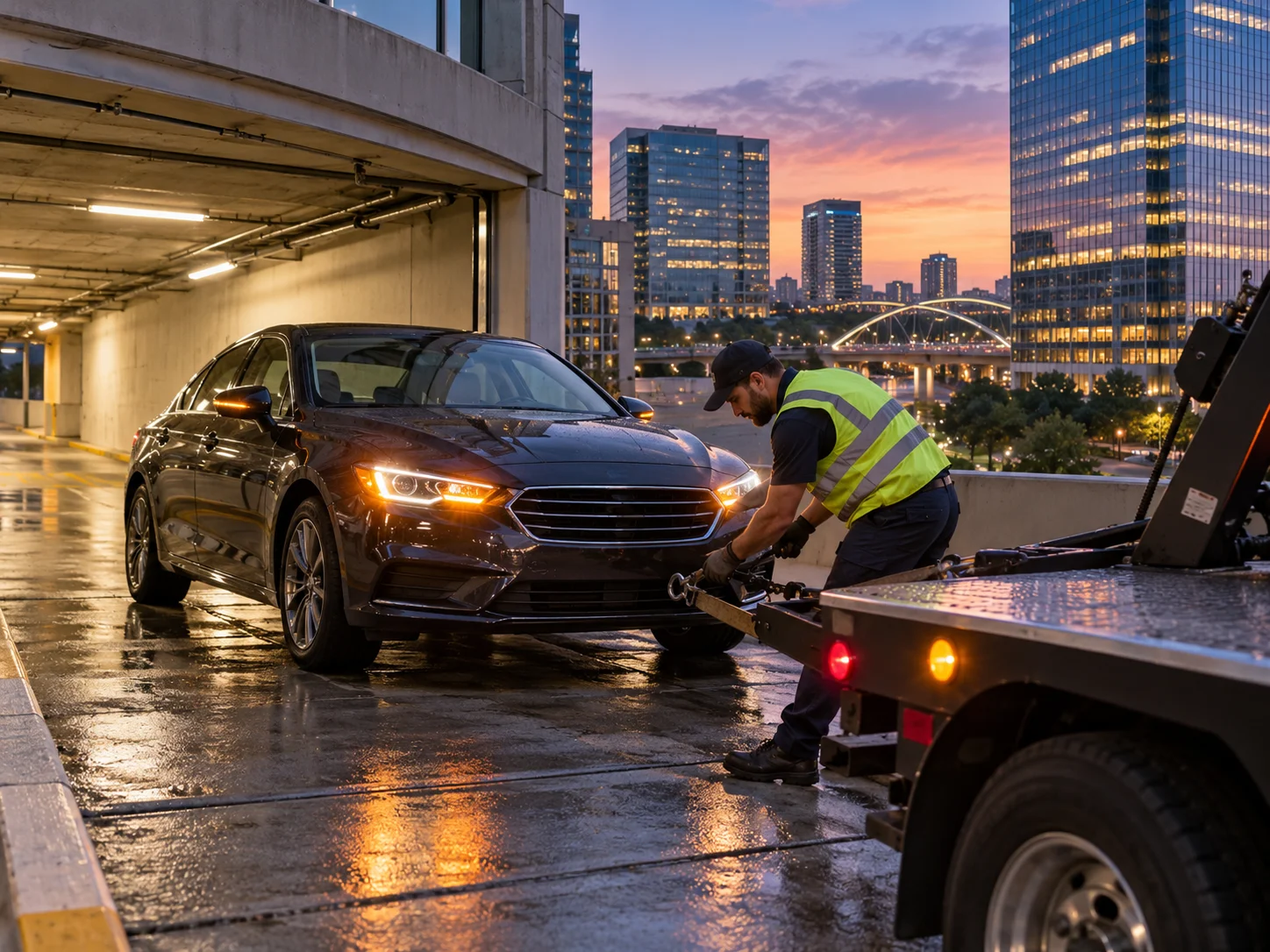
A garage stall in Las Colinas creates different problems than a highway shoulder. The vehicle may be protected from traffic, but the tow truck may face restricted clearance. Gates, ramps, columns, and sharp turns can limit access.
Start by checking the posted garage clearance. Tell dispatch which level holds the car. Describe whether it faces into the stall and whether nearby spaces are occupied. A vehicle against a wall or concrete stop may require a different approach.
Ask building security or property management how the operator should enter. Confirm the correct driveway and gate. If a ticket, access code, or escort is required, arrange it before the truck arrives. We can’t confirm individual building rules for you.
A standard tow truck may not fit inside every garage. The operator decides which equipment can safely reach and move the vehicle. Don’t promise garage staff that a specific truck type will work before the operator reviews the details.
Roadside breakdowns focus more on traffic exposure and loading space. Garages focus on clearance, turning room, and property access. Both calls still require the same basic facts: vehicle type, condition, location, destination, and contact information.
Sometimes towing isn’t needed. A jump start, tire change, lockout service, or fuel delivery may solve the immediate problem. Our guide to roadside assistance without AAA explains how to request help when you don’t have a motor-club plan.
If you search “roadside assistance near me,” don’t choose based only on map distance. Confirm that the operator can enter your garage and handle the actual vehicle problem.
Airport-adjacent lots without repeating the DFW 90-day parking post
Some Irving breakdowns happen near DFW Airport without happening on airport property. A hotel lot, office garage, public roadway, rental facility, and airport parking area can follow different access procedures.
Give dispatch the exact lot name and address. Don’t describe the location only as “at DFW.” Tell the operator whether you passed an airport entrance, parking gate, or security checkpoint. That detail helps establish how the vehicle can be reached.
If the car is inside a controlled lot, contact the lot operator first. Ask whether a tow truck needs authorization, an escort, or a specific entrance. Quick Tow Dallas doesn’t control airport or private-lot access.
Airport parking enforcement is also separate from a mechanical breakdown. DFW Airport has a parking limit and its own process for vehicles left beyond that limit. Our DFW Airport parking tow guide covers that specific situation. This page focuses on a car that won’t move under its own power.
Don’t assume an airport-adjacent vehicle was taken to an Irving facility. If a car has disappeared from a lot, contact the property manager or law enforcement agency responsible for that property. Ask which storage facility received it.
Irving has a city Auto Pound, but a complete public fee schedule could not be confirmed from the approved source material. Ask the facility holding the vehicle for its current charges, accepted payment methods, release documents, and retrieval instructions before traveling there.
What the operator confirms: destination, truck type, and price
The operator should confirm three core details before the truck rolls: pickup location, destination, and vehicle condition. Those details shape the equipment choice and the operator’s price.
For the pickup, give a complete address or accurate map pin. Add the road direction, garage level, entrance, or nearby exit. For the destination, provide the shop name and address. Confirm that the destination can accept the vehicle.
The operator also needs the vehicle’s year, make, model, and drive condition. Mention collision damage, missing wheels, locked steering, low clearance, or an electric drivetrain. Don’t guess whether a wheel-lift or flatbed is required. Let the operator decide after hearing the facts.
Quick Tow Dallas doesn’t set towing prices. The operator gives the price and handles payment. Ask what the quoted amount covers before authorizing dispatch. If the destination changes, ask how that affects the total.
There isn’t one verified Irving price that answers every cost question. The approved sources don’t provide a complete local fee schedule for ordinary consent tows. For that reason, we won’t publish an invented average, a “fair” flat amount, or a long-distance estimate.
For a long tow, including a trip measured in hundreds of miles, ask for the full destination-based price. Check whether your insurer, vehicle warranty, or motor-club plan includes towing benefits. Confirm any benefit directly with that provider.
Non-consent towing and vehicle storage follow different rules from a tow you request. The TDLR towing consumer information page explains consumer rights and complaint options. Dallas city fee rules aren’t automatically Irving rules, even though both cities are in the same metro.
How we connect you with a licensed Irving-area operator
When you call, we collect the information needed to route the request. We’ll ask where the vehicle is, what happened, and where it needs to go. We may also ask about access, damage, and whether the vehicle can roll.
We then connect you with an available operator serving the Irving area. Quick Tow Dallas is the dispatch and referral service. We don’t own the truck, employ the driver, or operate a storage yard. Your service agreement is directly with the operator.
Before authorizing the tow, confirm the operator’s business name. You can check a towing company or operator through the TDLR license search. Verify the license before handing over your keys.
Keep your phone available after dispatch. The operator may need clarification about a ramp, garage entrance, or vehicle position. Ask the operator for an arrival estimate, since traffic, distance, access, and availability can change.
Remove essential items when it’s safe and allowed. Take your wallet, medication, work equipment, garage pass, and house keys. Photograph the vehicle’s condition and its surroundings before loading. Don’t delay in an exposed traffic area to gather nonessential items.
If the operator can’t reach the vehicle with the expected equipment, explain the access problem again. A garage clearance issue or damaged wheel may require another plan. Clear information at intake reduces avoidable rerouting.
When to call us
Call when your vehicle can’t safely continue, needs professional loading, or is trapped inside a restricted garage. Call us at (469) 902-4411 and we’ll connect you with an operator who handles this work.