A disabled motorcycle in Garland needs more than a pickup address. The operator must understand the bike, damage, access, and destination before accepting the job.
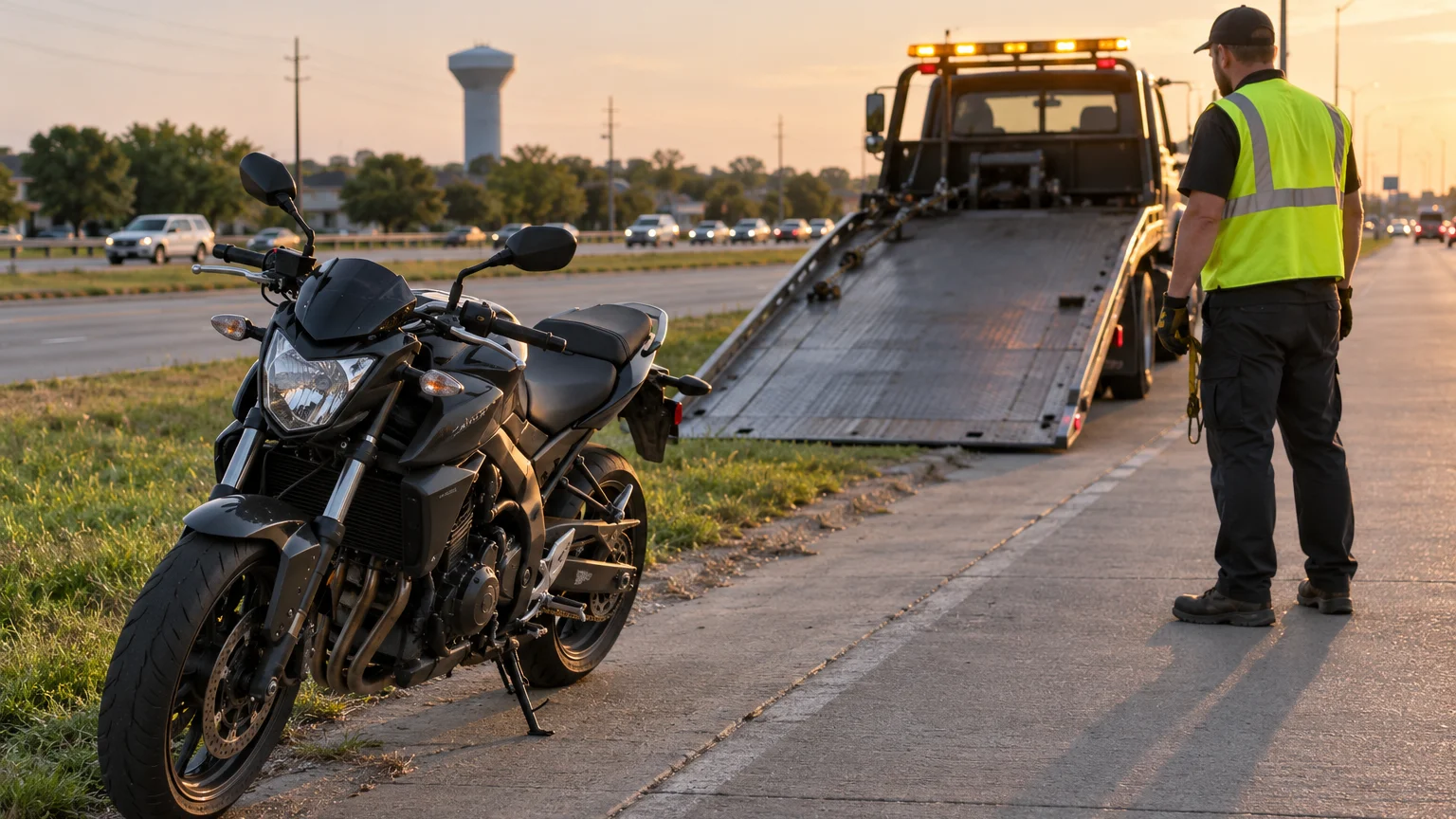
Good dispatch details matter near I-30, US 78, and President George Bush Turnpike. Start with what you can see, then let the operator decide what the tow requires.
Identify the motorcycle and its condition
Begin with the motorcycle’s year, make, and model. If you don’t know the exact model, describe the style. Say whether it’s a cruiser, touring bike, sport bike, scooter, or three-wheeler. Mention any luggage, fairings, side cases, or other attached parts.
Then explain why the bike can’t continue. A motorcycle with a dead battery presents a different situation from one with collision damage. Tell the dispatcher whether the problem involves the engine, tires, controls, chain, steering, or visible body damage. Don’t diagnose a problem you can’t confirm. A direct description is more useful.
Say whether the motorcycle is upright or on its side. Report leaking fluid, loose panels, broken controls, or parts touching the ground. If the bike was involved in a crash, identify the damaged area you can see. Don’t move damaged pieces just to inspect underneath them.
The operator also needs to know whether the motorcycle rolls. Explain whether either wheel appears blocked, bent, flat, or out of alignment. State whether the handlebars turn normally. If you haven’t tested something, say that it’s unknown.
Our motorcycle towing service connects Garland callers with licensed, insured towing operators. Quick Tow Dallas handles intake and referral. The operator performs the tow and decides whether the motorcycle fits the operator’s capabilities.
For more preparation details, read our Dallas motorcycle towing guide. That guide covers the broader Dallas area. This page focuses on the location and access details that matter during a Garland dispatch.
Share wheel, steering, and access details
Wheel and steering details help the operator understand the motorcycle’s current condition. You don’t need mechanical terminology. Describe what happens, or what you can see, without forcing the bike to move.
Tell the dispatcher whether the front wheel points straight or sits at an angle. Mention a locked steering column if you already know it’s locked. If the keys are missing, say so. The operator should know that before accepting the request.
Report whether the front and rear tires appear inflated. Note visible wheel damage, a displaced chain, or parts caught near a wheel. If the motorcycle won’t roll, don’t guess why. State which wheel seems unable to move and how you discovered that.
Access is just as important. A bike in an open Garland parking lot differs from one inside a gated apartment complex. Describe gates, parking decks, narrow drive aisles, low overhead areas, steep ramps, soft ground, and tight corners. Say whether another vehicle blocks direct access.
Provide any entry instructions you’re authorized to share. If a property manager, security desk, or gate attendant controls access, tell the dispatcher. Don’t promise that an operator can enter until the property gives permission.
Garland includes dense commercial areas, apartment properties, neighborhood streets, and major highway corridors. A street address alone may not show where the motorcycle sits within a large property. Give the building, entrance, row, level, or nearby storefront when available.
These facts let the operator evaluate the request. They don’t replace the operator’s inspection. The operator may ask follow-up questions before confirming capability, price, or dispatch.
Describe the pickup point without choosing equipment
Focus on the motorcycle’s position and surroundings. You don’t need to select the tow truck or tell the operator how to load it. Equipment decisions belong to the towing professional who accepts the job.
Start with the full pickup address when one exists. Add the business name, apartment building, garage level, or parking section. If the motorcycle is beside a road, share the road name, direction of travel, nearest cross street, and a recognizable landmark.
Describe the surface beneath the bike. It may be pavement, gravel, grass, mud, or another surface. Mention a slope, curb, median, ditch, or confined parking space. Report these conditions without attempting a recovery yourself.
Some callers ask for a specific truck because they’ve heard one method is better. It’s fine to explain your concerns, especially when the motorcycle has low bodywork or collision damage. The operator still determines what equipment is suitable. Our flatbed towing page explains that service category, but it isn’t a promise that every motorcycle request needs or receives a flatbed.
The destination matters too. Give the repair shop, residence, dealership, or other authorized destination. Confirm that the destination can receive the motorcycle. Tell the operator about gates, restricted access, or enclosed parking at the drop-off point.
Quick Tow Dallas doesn’t own trucks or choose equipment for an operator. We connect the caller with a licensed, insured operator who reviews the request. The customer contracts directly with that operator.
Before the truck rolls, confirm the destination and price with the operator. Ask what information remains unresolved. If the motorcycle’s condition changes while you wait, update the operator rather than assuming the original plan still applies.
I-30 and US 78 calls need precise location details
A motorcycle stopped near I-30 or US 78 can be difficult to locate from a pin alone. Direction, nearby exits, and the correct roadway name help distinguish one pickup point from another.
For an I-30 call, state whether you were traveling east or west. Give the most recent exit passed or the next visible exit when you know it. Say whether the bike is on the main lanes, a frontage road, an entrance ramp, or an exit ramp. Don’t describe it only as “near Garland.”
US 78 runs through Garland on a different alignment. State your travel direction and the nearest cross street, business, or visible landmark. Make clear whether you’re on US 78 itself or on a nearby local street.
President George Bush Turnpike also needs precise wording. Provide your direction of travel and the nearest confirmed interchange or exit. Don’t guess at an exit number. If your map shows a different road name than a nearby sign, share both and explain which one you can see.
A phone location pin can support these details, but it shouldn’t replace them. Pins may land on the wrong side of divided roads or near a parallel frontage road. Read the location back to the operator and correct any mismatch.
Our Garland I-30 and US 78 dispatch guide gives more detail about describing those corridors. It applies to general towing calls, while this page addresses the motorcycle information an operator needs.
If you’re unsure whether the motorcycle sits inside Garland, say so. Nearby municipal boundaries can affect how a location is described. Give the exact map address or coordinates and let the operator confirm the service location.
What the operator confirms before accepting the tow
The operator should confirm that the company handles motorcycles and can address the condition you described. That decision belongs to the operator, not the referral service.
Expect questions about the bike’s size, damage, wheel movement, steering, keys, and access. The operator may also confirm the pickup point, destination, and contact person. Answer with observed facts. Mark anything uncertain as unknown.
The operator sets the price. Quick Tow Dallas doesn’t publish or set a motorcycle towing rate. Confirm the price directly with the operator before the truck rolls. Explain any access issue or condition that could affect the request, then ask the operator to account for it.
You can also verify a towing operator through the TDLR license search. Texas towing operator and company licenses are administered through the Texas Department of Licensing and Regulation. TDLR also provides consumer information about towing.
Ask who will receive the motorcycle at the destination. A repair shop may have its own intake process, access limits, or key instructions. Those details come from the destination and operator, not Quick Tow Dallas.
The operator should know about crash damage, leaks, blocked wheels, missing keys, and restricted access before accepting the tow. Don’t leave those facts for the arrival inspection if you already know them.
If the operator can’t confirm capability, don’t treat that as a minor detail. The request needs a licensed towing professional who accepts the motorcycle’s actual condition and locations. Clear information gives the operator a fair basis for that decision.
When to call us
Call when a disabled or damaged motorcycle in Garland needs a licensed towing professional. Have the bike details, condition, pickup point, access notes, and destination ready.
Call us at (469) 902-4411 and we’ll connect you with an operator who handles this work.