If you need a tow truck in Garland, dispatch first needs your exact location. The road, travel direction, vehicle details, access conditions, and destination all affect which operator can accept the call.
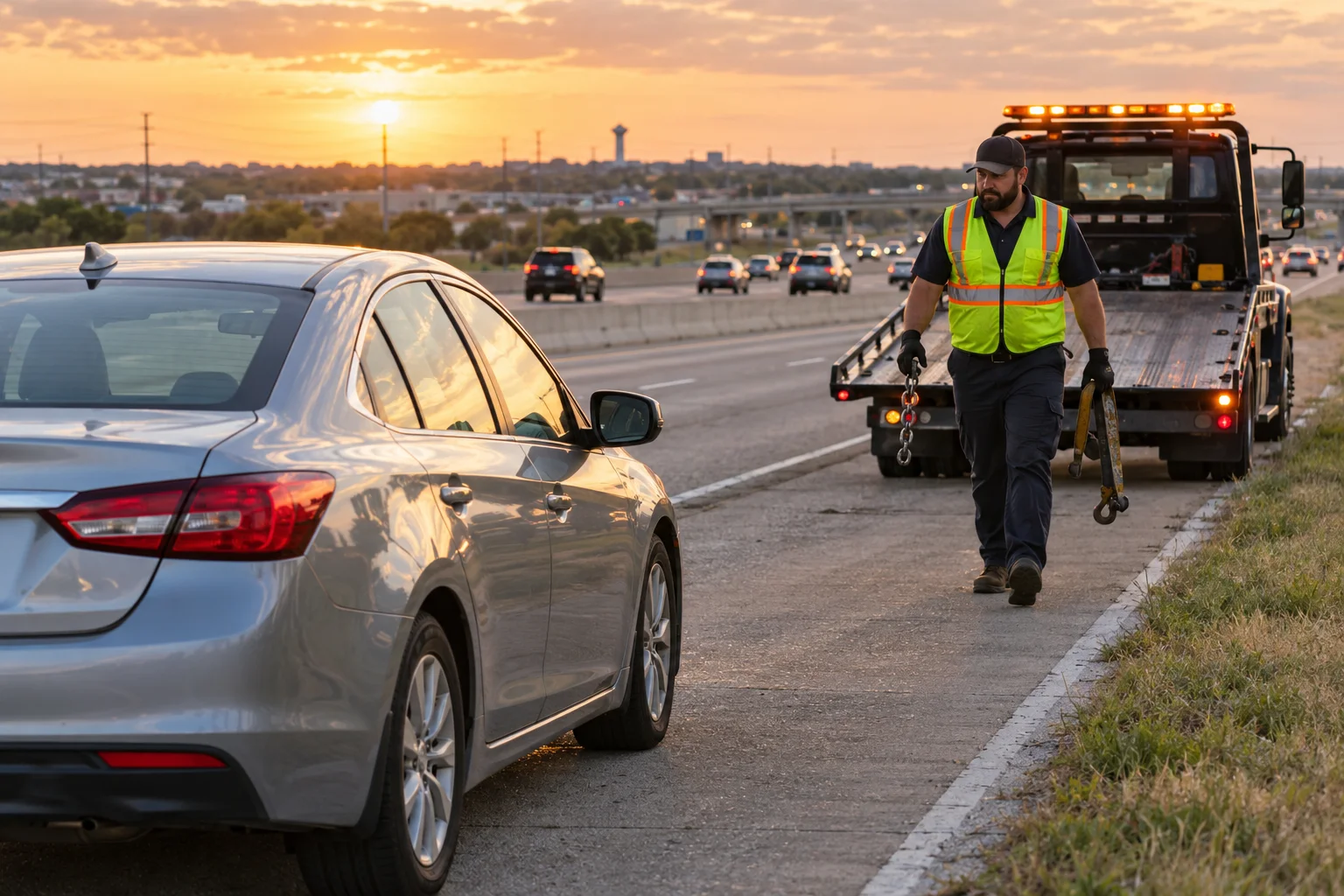
Quick Tow Dallas connects callers with licensed, insured towing operators. We don’t own trucks or perform towing. You’ll contract directly with the operator who accepts the job.
Share the road, direction, and nearest safe access point
Start with the road name and your direction of travel. “I’m on I-30” doesn’t tell dispatch which side can reach you. Say whether you were traveling east or west. On President George Bush Turnpike, give your travel direction and the last exit, entrance, or cross street you passed.
Share a phone location pin when possible. Then describe what you see around the vehicle. A nearby exit number, frontage road, shopping center entrance, or named cross street can help confirm the pin. Don’t rely on a business name alone. Large properties may have several entrances.
Tell dispatch where the vehicle actually stopped. It may be on a shoulder, frontage road, parking lot, apartment drive, garage, or private driveway. Also mention gates, clearance limits, tight turns, or blocked access. A truck suited for an open roadside may not suit a low garage.
If you moved away from the vehicle, say so. Give the vehicle’s location first, followed by your location. Dispatch needs to route the operator to the car.
For calls involving traffic control, a collision scene, or an official road closure, follow directions from the police or roadway authority at the scene. We can’t confirm Garland roadway procedures that aren’t listed in the approved public record. The responding agency can explain what access is allowed.
Our emergency towing service page explains what to have ready before calling. For a broader checklist, see our guide to finding a tow truck near you in Dallas.
I-30 and US 78 calls need different location details
Garland’s major corridors create different dispatch problems. The route name still isn’t enough.
For an I-30 call, identify eastbound or westbound travel. Give the last exit you passed and the next exit you can see, if known. State whether the vehicle is on the main lanes, a frontage road, an exit ramp, or nearby private property. An operator may need a different approach depending on where the car stopped.
For US 78, include the nearest named cross street or property entrance. Tell dispatch which direction you were traveling and which side of the roadway holds the vehicle. If you turned into a parking lot after the problem started, provide the lot entrance rather than your earlier road position.
On President George Bush Turnpike, share your travel direction and the closest confirmed access reference. Don’t guess an exit number. A correct cross street or location pin is more useful than an uncertain marker.
You should also tell dispatch whether the car can roll, steer, and shift into neutral. Those details help the operator decide what equipment may fit the recovery. The operator makes that decision, not the referral line.
Don’t assume a Garland mailing address settles the responding jurisdiction or roadway procedure. We couldn’t confirm a single rule that applies to every I-30, US 78, and PGBT towing call. If an agency controls the scene, ask that agency whether you may choose an operator. If no agency is involved, dispatch can seek an available licensed operator for the location you provide.
Describe the vehicle and what stopped working
Dispatch needs the vehicle’s year, make, model, and color. Say whether it’s a sedan, SUV, pickup, motorcycle, van, or another vehicle type. Mention a trailer, cargo load, modification, or obvious damage that could affect loading.
Next, describe what happened without trying to diagnose it. Useful statements include “the engine shut off,” “the tire is flat,” or “the vehicle won’t shift.” Tell dispatch if the wheels are locked, steering is damaged, or parts are touching the ground. If there was a collision, say whether the vehicle remains on the roadway or has been moved.
A dead battery, flat tire, lockout, or similar problem may call for roadside assistance in Garland instead of a tow. Dispatch will ask questions and connect you with an operator who handles the requested work. The operator decides what service and equipment the situation requires.
Don’t leave out parking conditions. A disabled car inside a low-clearance garage needs different access than one in an open lot. Share the posted clearance if you can read it without entering a restricted or unsafe area. Note any gate, access code, loading dock, or sharp turn.
Your destination matters too. Give the repair shop, residence, or other requested drop-off location. Confirm whether someone can receive the vehicle there. If you haven’t chosen a destination, say that before dispatch begins seeking an operator.
Drivers without a motor club can review our guide to roadside assistance without AAA in Dallas. Coverage and reimbursement depend on the driver’s own policy or membership, so confirm those terms directly.
Separate roadside towing from an impound situation
A roadside breakdown and an impound are different calls. If the vehicle is still where you left it, dispatch needs its location and condition. If it has disappeared from private property or after an official action, first determine whether it was already towed.
Ask the property manager or the agency that ordered the removal which storage facility received the vehicle. Don’t request a roadside tow until you know the car has been released and can legally leave the facility.
Garland records identify a city lot at 1630 Commerce, Garland, TX 75040. The approved source doesn’t publish its current fees. Confirm the vehicle’s location, required documents, accepted payment methods, release conditions, and current charges directly with the facility or ordering agency before traveling there.
Texas regulates towing through the Texas Department of Licensing and Regulation. Its consumer towing information explains the state framework. You can also use the TDLR license search to check an operator or towing company before handing over your keys.
Don’t use Dallas Auto Pound instructions for a Garland impound unless the ordering agency specifically sends you there. Dallas and Garland are separate jurisdictions, and the approved record doesn’t establish one shared release process.
Once the facility authorizes release, tell dispatch that the vehicle is leaving an impound lot. Provide the facility address, destination, vehicle condition, and any pickup instructions the facility gave you. The towing operator can then decide whether to accept the transfer.
What the operator confirms before accepting the call
Quick Tow Dallas handles intake and referrals. We pass the call details to a licensed, insured operator suited to the requested work. The operator performs the service, sets the price, and contracts directly with you.
Before the truck rolls, confirm the pickup address, vehicle, requested service, and destination with the operator. Ask the operator for the full price and any conditions tied to access, mileage, vehicle condition, or the requested equipment. Quick Tow Dallas doesn’t set towing rates or promise a price shape.
Ask for an arrival estimate directly from the operator. Availability can change, especially when a vehicle is on a major corridor or needs specialized equipment. We don’t promise a response time.
The operator may ask whether the vehicle can steer, roll, brake, or shift. Answer as accurately as you can. If you don’t know, say so. Guessing can send equipment that doesn’t fit the job.
Confirm who will meet the driver and who can authorize the tow. If the registered owner won’t be present, ask the operator what authorization is required. We couldn’t confirm one Garland-wide procedure covering every private pickup, repair shop, garage, and impound transfer. The operator and property controlling the pickup location set the practical access requirements for that job.
Before releasing the keys, verify the operator through TDLR’s license search. Also confirm the destination one more time. Similar business names and multiple entrances can cause confusion, especially when the drop-off location is closed or spread across a large property.
Clear answers at this stage reduce avoidable delays. They also let the operator decline a job that needs different equipment or access.
When to call us
Call when a disabled vehicle in Garland needs a licensed towing operator, or when roadside assistance won’t solve the problem. Have the road, direction, vehicle details, access notes, and destination ready.
Call us at (469) 902-4411 and we’ll connect you with an operator who handles this work.