Car towing to another state starts with a clear plan. The operator needs to know where the vehicle sits, where it’s going, and what condition it’s in. Those details help determine whether a towing operator can accept the trip.
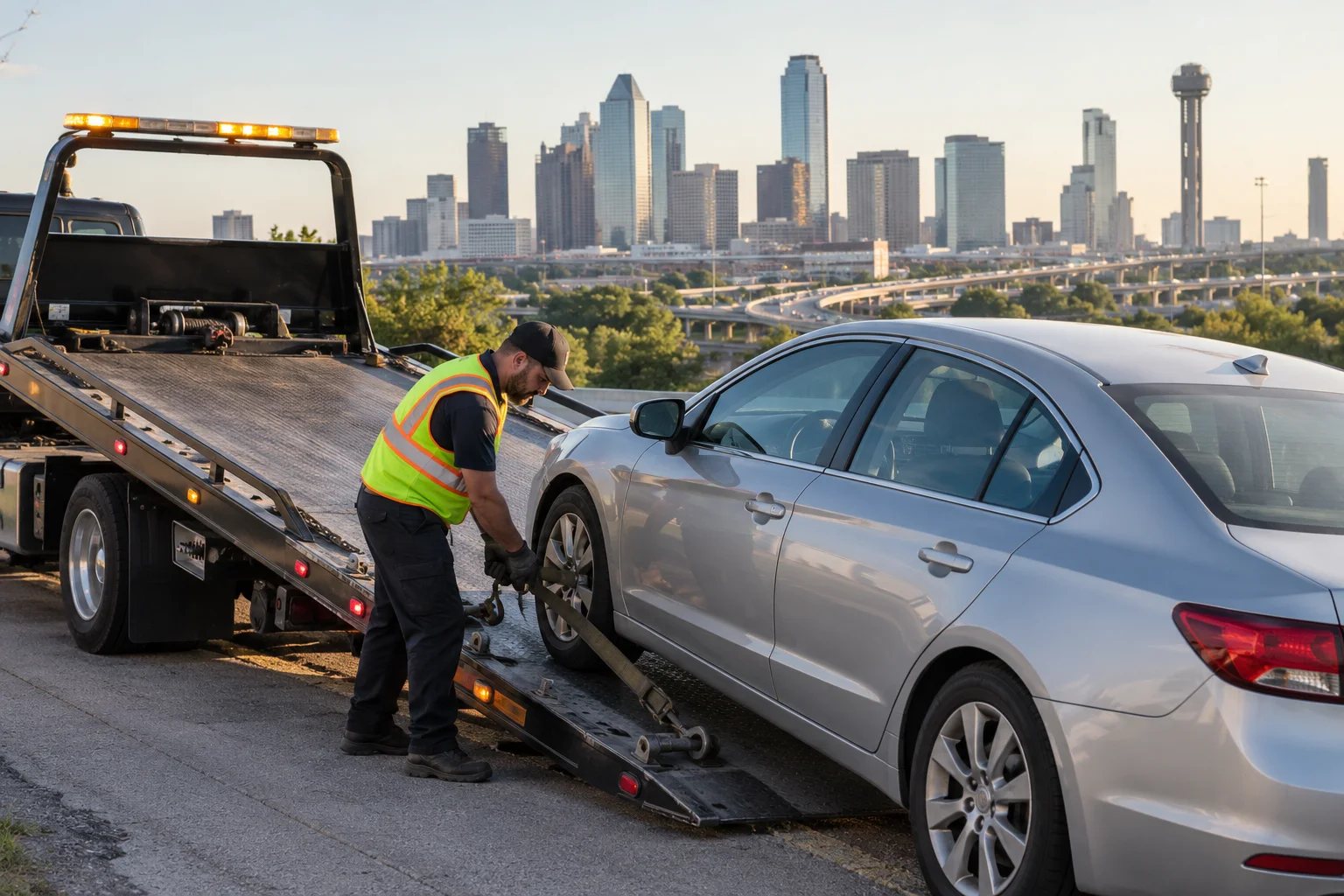
Quick Tow Dallas is a dispatch and referral service. We connect callers with licensed, insured towing operators. The customer contracts directly with the operator who accepts the work.
Give dispatch the exact pickup and destination
“Dallas to another state” isn’t enough for dispatch. Start with the complete pickup address and the vehicle’s exact position. A car beside I-35E presents a different pickup than one inside a Downtown garage.
Name the nearest cross street, building, entrance, or highway marker. Mention whether the vehicle is on a shoulder, in a driveway, or behind a gate. If it’s near the Mixmaster, High Five, or I-635 LBJ, share the direction of travel. That can prevent confusion between opposite sides of a divided highway.
The destination also needs a complete address. Give the business or recipient’s name when applicable. Confirm that the address is the final delivery point, not an office that sends vehicles elsewhere.
Dallas-area pickup distances matter before the interstate trip begins. A vehicle in Oak Cliff may reach I-35E differently than one in North Dallas. Garland pickups may approach I-30 or US-75. Plano and Frisco requests begin in Collin County, often near the Dallas North Tollway, PGBT, or Sam Rayburn SH-121. Tell dispatch the actual city and county instead of calling every location Dallas.
Our long-distance towing service page explains how we refer these requests. For a pickup farther north, the McKinney dispatch guide covers details specific to that corridor.
Share both addresses before asking about price. The operator sets the price and confirms it before rolling. Quick Tow Dallas doesn’t set towing rates, mileage charges, or payment terms.
Share the vehicle condition and access limits
The operator needs an honest description of the vehicle. Start with the year, make, model, and vehicle type. Then explain why it can’t be driven.
Say whether the engine starts. Mention flat or missing tires, steering trouble, collision damage, or wheels that won’t turn. Tell dispatch if the keys are available. Also disclose loose body panels, fluid leaks, or parts touching the ground.
Don’t guess about the required equipment. Describe the condition and let the operator decide. A flatbed towing operator may be appropriate for some vehicles, but that choice depends on the vehicle, damage, access, and accepted trip.
Access can change what’s practical. Share garage height restrictions, narrow alleys, locked gates, steep driveways, and soft ground. A vehicle parked nose-first against a wall may require a different approach than one in an open lot. Photos can help if the operator asks for them.
A breakdown near I-30, I-45, Loop 12, or US-75 also needs a precise safety description. Tell dispatch whether the car is fully outside active traffic. Don’t stand beside traffic while collecting information. Move to a safer location when you can do so without entering a travel lane.
Remove personal items before pickup when possible. Don’t leave medication, identification, house keys, or travel documents inside. Ask the operator what may remain in the vehicle. No approved statewide packing rule for this kind of trip could be confirmed from the supplied claims ledger. The accepting operator should explain any limits before pickup.
Confirm who can release and receive the vehicle
A long-distance trip has two handoffs. Someone must make the vehicle available in Dallas. Someone must also accept it at the destination.
Give the operator each person’s name and reliable contact information. If you won’t attend pickup, explain who will provide the keys and access. Don’t assume a landlord, repair shop, dealership, apartment office, or storage property can release the car for you.
Ask the pickup location what authorization it requires. The approved claims ledger doesn’t establish one universal release document for every private property, repair facility, or destination state. The property holder and accepting operator should confirm what they need.
The same care applies at delivery. Confirm that the destination accepts vehicles from towing operators. Ask where the car may be placed and who can receive the keys. A repair shop’s street address may not identify its vehicle entrance or after-hours drop area.
If no one will be present, get the operator’s approval before relying on an unattended delivery. Don’t leave that decision until the vehicle reaches another state. Access may be restricted by a gate, crowded lot, local parking rule, or property policy.
Verify the operator before handing over the vehicle. Texas towing operators are licensed through the Texas Department of Licensing and Regulation. You can use the TDLR license search to check an operator.
Keep the operator’s business name and agreed handoff details. Confirm who holds the keys at each stage. Also ask whom the destination should contact if access changes while the vehicle is moving.
Separate towing from other vehicle transport options
A disabled car that needs direct recovery isn’t the same request as a working car being moved during a relocation. Both may cross state lines, but the service setup can differ.
Long-distance towing may fit when the car can’t operate safely or needs pickup from a breakdown location. Vehicle shipping may fit a working car moved between planned locations. Neither option is always cheaper, faster, or better.
We couldn’t confirm universal mileage rates, delivery times, carrier schedules, or a cheapest method from the approved claims ledger. Ask each provider what service it’s offering. Compare the full pickup and delivery arrangement, not just a headline price.
For towing, confirm that the quoted work covers the stated Dallas pickup and final destination. Ask how changes in the vehicle’s condition or access could affect acceptance. Our guide to long-distance tow costs from Dallas explains which trip details to gather without publishing an invented brand rate.
For vehicle shipping, ask whether the car must run, steer, brake, or roll. Ask whether pickup and delivery occur at your addresses or other meeting points. Those requirements weren’t confirmed in the claims ledger, so the shipping provider must state its own terms.
Searchers also encounter references to a “$3000 rule” for cars. No such towing or transport rule was confirmed in the supplied Texas claims ledger. Don’t treat that phrase as a legal threshold or planning standard. Ask the provider what it means in its specific context and verify any claimed government requirement with the named authority.
The useful comparison is simple: what service is being provided, who accepts the vehicle, and what happens at delivery.
What the operator confirms before accepting the trip
The towing operator decides whether the request fits its equipment, service area, and operating plans. Quick Tow Dallas gathers the trip details and refers the request. We don’t transport the vehicle or decide which equipment can handle it.
Before accepting, the operator should have enough information to evaluate:
- The exact pickup and destination addresses
- The vehicle’s year, make, model, and condition
- Whether the vehicle rolls, steers, and has usable tires
- Key availability and release authorization
- Pickup and delivery access limits
- The people handling both vehicle handoffs
- The requested pickup arrangement
- The price, payment terms, and any operator conditions
Ask the operator to confirm the destination before the truck rolls. Make sure the quoted trip matches the actual vehicle and both addresses. The operator sets the price, so direct every price question to that operator.
Interstate licensing, insurance, registration, and documentation requirements can depend on the service and route. Specific requirements weren’t confirmed in the approved claims ledger. Don’t rely on a competitor’s checklist or an unexplained online claim.
Start by checking the Texas operator through TDLR. The department also publishes consumer information about towing. If the operator says another government authority controls part of the trip, ask for that authority’s name and verify the requirement directly.
Weather and road conditions can affect the route. Dallas hail, summer heat, and winter ice can complicate pickup conditions. Congestion around the High Five, Mixmaster, I-35E, and I-635 can also shape the operator’s plan. Ask the operator for its current arrival estimate and delivery expectations. Quick Tow Dallas doesn’t promise either.
When to call us
Call when a disabled vehicle in Dallas needs a licensed towing operator for an out-of-state destination. Have both addresses, the vehicle condition, access details, and handoff contacts ready.
Call us at (469) 902-4411 and we’ll connect you with an operator who handles this work.