RV towing in Lewisville starts with matching the disabled unit to a qualified operator. Dispatch needs separate details about the RV, trailer, tow vehicle, location, and destination before making that match.
A breakdown near I-35E calls for different planning than one inside a commercial storage property. Clear information helps the operator decide whether the job fits their equipment before accepting it.
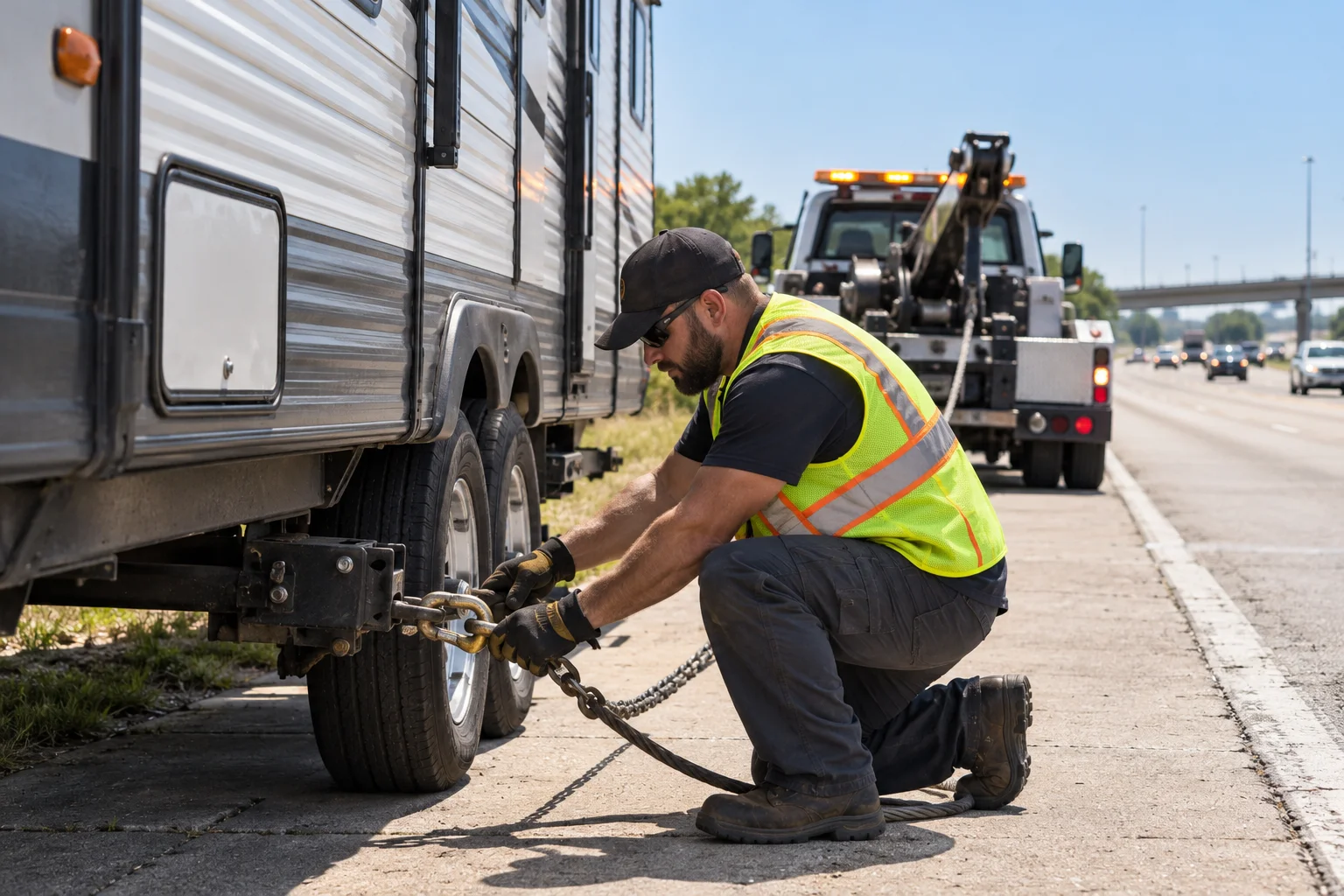
Identify the RV, trailer, and tow vehicle separately
Start by explaining exactly what’s disabled. “My RV broke down” can describe several very different combinations. The operator needs each unit identified on its own.
For a motorhome, share the manufacturer, model, model year, and body style shown in its documents. Tell dispatch whether it’s pulling a car, utility trailer, or another unit. Don’t combine the attached vehicle with the motorhome when describing the problem.
For a travel trailer, identify the trailer and its tow vehicle separately. State whether the trailer is still connected. Describe the connection shown in the manufacturer’s paperwork. It might be a bumper-pull, fifth-wheel, or another setup. If you don’t know the connection type, send a clear photo instead of guessing.
A trailer problem also doesn’t always mean the tow vehicle has failed. Tell dispatch which unit can move, which can’t, and whether either one has visible damage. Mention detached parts, a dropped connection, or anything resting against the pavement. The operator will decide how those conditions affect the job.
This distinction matters when you’re looking for RV and trailer towing. A referral service can’t select an operator from the word “RV” alone. Quick Tow Dallas identifies the job and connects you with a licensed, insured towing operator. We don’t own recovery equipment or transport the unit ourselves.
For a broader look at the information dispatch requests across the metro, read our Dallas RV and trailer dispatch guide.
Find the unit specifications before calling
The operator needs manufacturer information, not a visual estimate. Check the RV or trailer documents for the exact specifications available there. Useful sources may include the owner’s packet, registration, manufacturer label, or a digital manual tied to the model.
Write down the full manufacturer and model names. Include the model year and identification number if they’re available. Share the listed length and weight specifications exactly as written. Don’t round a measurement or substitute the tow vehicle’s rating for the trailer’s information.
Keep the units separate when reading those documents. A motorhome, travel trailer, tow vehicle, and attached car can each have different specifications. Label each number before sending it. A simple note on your phone can prevent the figures from getting mixed together during the call.
If a label is damaged or unreadable, say that plainly. Don’t estimate the unit’s weight from its appearance. Tell dispatch which facts you confirmed and which remain unknown. The operator can then decide whether more documentation or photos are needed.
Photos should show the whole unit from several angles. Add close views of the wheels, connection point, and visible damage. Keep document text private unless the operator specifically needs a field from it.
Some RV calls may need an operator who handles heavy-duty towing. That decision belongs to the operator after reviewing the specifications. Our guide to heavy-duty towing in Dallas explains the same matching process for larger vehicles.
Share wheel condition, access, and exact location
Next, describe how the unit sits. Count the visible wheels and identify any wheel that appears damaged, missing, locked, or out of position. Report what you can see without diagnosing the cause. “The left rear tire is flat” gives dispatch more useful information than “the axle is broken” when no mechanic has confirmed that diagnosis.
Tell dispatch whether the RV or trailer is upright and fully on pavement. Mention a shoulder, grass edge, ditch, curb, tight turn, gate, low cover, or narrow parking lane. These details help the operator review access before accepting the call. Photos can show space more clearly than a general description.
Send an exact location instead of naming only Lewisville. A map pin is useful when the street address isn’t obvious. Include the road, direction of travel, nearest cross street, and a visible business or property entrance. If you’re near I-35E, say whether you’re on the main lanes, frontage road, ramp, or nearby property.
Use the same precision around SH 121 and Business 121. Those names aren’t interchangeable. State which road appears on your map and share your direction of travel. If you left the highway, identify the entrance you used and where the unit stopped after entering.
If a label or photo is unavailable, tell dispatch that the detail is unavailable. The operator can ask follow-up questions and decide what information is essential.
Also explain the immediate problem. Common descriptions include no-start, flat tire, separated connection, collision damage, or a unit that won’t roll. Describe symptoms only. The operator will determine what service and equipment the situation requires.
I-35E and local storage sites require different details
An RV disabled along I-35E presents a different access picture from one parked at a Lewisville storage property. On I-35E, dispatch needs your direction, roadway position, and nearest confirmed reference point. A location pin helps distinguish the main lanes from the frontage road or an adjoining lot.
For SH 121 or Business 121, read the road name directly from your map. Include the direction you were traveling and whether the unit is on a ramp, service road, or commercial property. Don’t assume dispatch can identify your location from a nearby store name alone.
Inside a storage area, focus on property access. Provide the site name, street address, gate location, unit space, and the path to the RV or trailer. Mention narrow rows, covered spaces, sharp turns, or parked vehicles that limit access. State what you observe, but let the operator decide whether the available space works.
Storage-site rules and access procedures weren’t confirmed for a specific Lewisville property. Contact the property manager before pickup. Ask who may open the gate, whether the operator needs prior approval, and where the unit may be collected. Don’t promise the operator access based only on your entry code.
The destination matters just as much as the pickup. Provide its full address and confirm that the receiving property expects the unit. Ask the destination about its own gate and placement process. If you haven’t chosen a destination, tell dispatch. The operator needs that fact before deciding whether to accept the job.
Clear pickup and destination details reduce avoidable follow-up. They don’t guarantee that a particular operator can take the call. Capability depends on the full unit information, access, condition, and requested move.
What the operator confirms before accepting the job
The operator reviews the unit type, manufacturer specifications, wheel condition, connection, access, pickup point, and destination. They may request more photos or ask you to read a specific field from the manufacturer’s documents.
They’ll also determine whether their available equipment fits the job. Quick Tow Dallas doesn’t make that technical decision and doesn’t claim to own heavy recovery equipment. We gather the details and route the request to an operator who can evaluate it.
Before a truck rolls, confirm the scope directly with the operator. Make sure they understand every unit involved, including an attached trailer or vehicle. Repeat the pickup and destination addresses. Mention any gate, cover, narrow lane, damaged wheel, or part touching the ground.
The operator sets the price. Ask what the quoted amount covers before authorizing dispatch. If the condition, access, or destination changes, ask how that affects the job and price. Quick Tow Dallas doesn’t set a brand towing rate.
You can review the TDLR towing consumer information before handing over the unit. You can also check a towing company or operator through the TDLR license search. Texas towing operator and company licenses are handled through TDLR.
The customer contracts directly with the operator performing the work. Keep the operator’s company name and the agreed destination available. If someone else owns the RV, trailer, or tow vehicle, tell the operator before pickup and ask what documentation they require.
Unknown details don’t prevent you from calling. Mark them as unknown instead of filling gaps with estimates. Accurate partial information is more useful than a complete description built from guesses.
When to call us
Call when an RV, trailer, or tow vehicle can’t move and the job needs a licensed towing operator. Have the unit documents, photos, location, access notes, and destination ready if available.
Call us at (469) 902-4411 and we’ll connect you with an operator who handles this work.