A disabled box truck in Irving needs a carefully matched towing operator. Dispatch needs more than a vehicle nickname and a pin on a map. Clear specifications, cargo details, and wheel condition help the operator decide whether to accept the job.
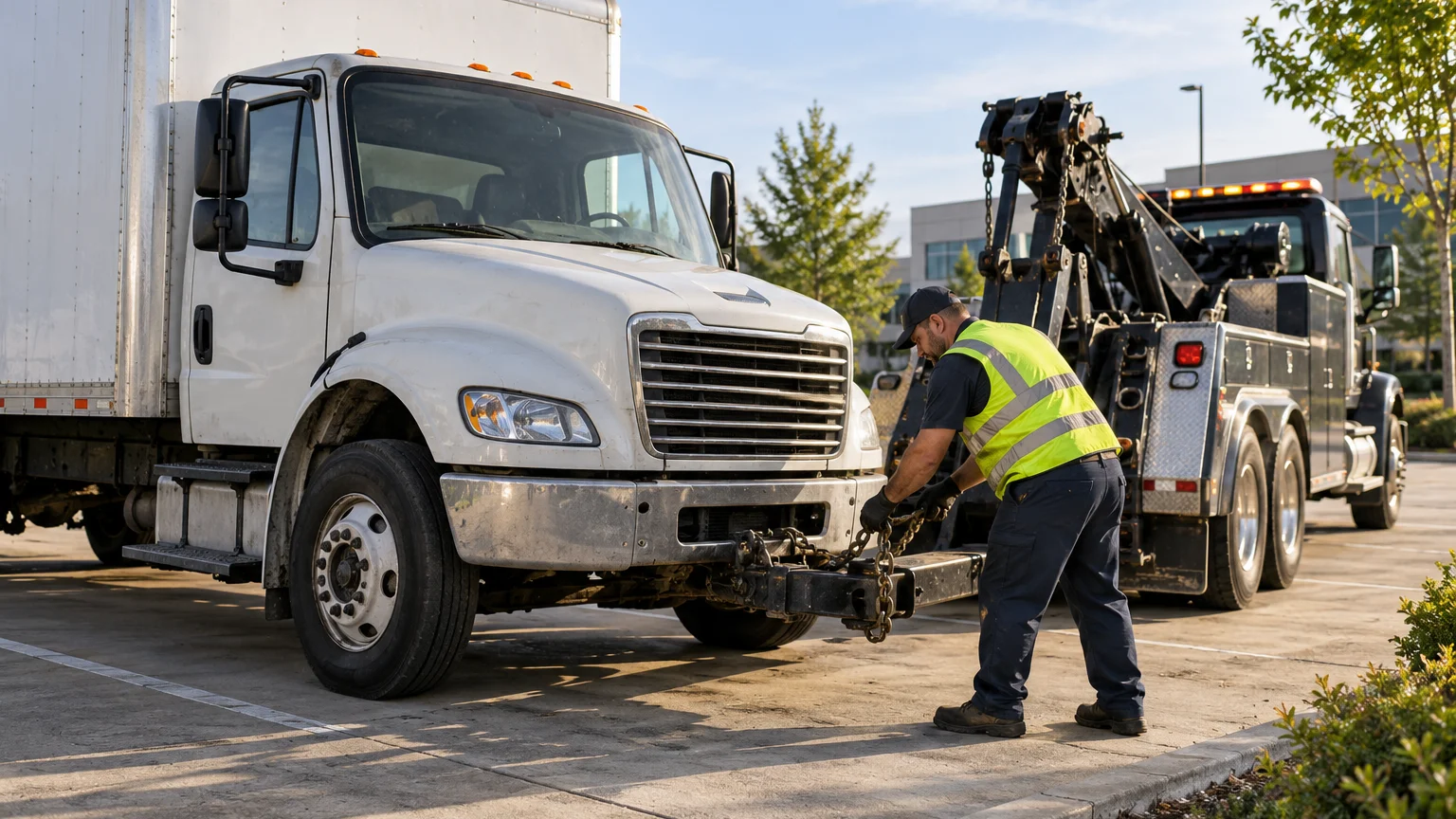
Quick Tow Dallas is a dispatch and referral service. We connect callers with licensed, insured operators who handle heavy-duty towing. The operator confirms capability and sets the price before rolling.
Identify the vehicle and its configuration
Start with the exact vehicle in front of you. “Work truck” or “box truck” doesn’t give dispatch enough information. Vehicles with similar bodies can have different frames, axles, attachments, and operating weights.
Give dispatch the manufacturer, model, and model year when available. State whether it’s a straight truck, tractor, box truck, service truck, pickup, or another configuration. Count the axles rather than guessing from memory. If a trailer is attached, describe it separately and explain whether it can be disconnected.
Tell dispatch which end of the vehicle is accessible. A truck backed against a dock presents a different pickup than one facing an open parking aisle. Mention nearby walls, gates, loading areas, parked vehicles, or overhead structures. Don’t assume the operator can approach from either direction.
The drivetrain and transmission also matter. Share whether the vehicle is front-wheel drive, rear-wheel drive, four-wheel drive, or all-wheel drive if documents confirm it. Tell dispatch whether the transmission can shift into neutral. Don’t crawl beneath the vehicle or attempt a mechanical disconnect yourself.
A commercial vehicle may have added equipment that changes the job. Examples include liftgates, utility bodies, tool compartments, tanks, racks, and mounted machinery. Describe what’s installed without assigning it a weight or equipment class.
Our Dallas heavy-duty towing guide explains the same core principle across the wider service area: the operator must match the actual vehicle, not its nickname. Photos can help, but they don’t replace reliable specifications.
Use reliable documents for vehicle specifications
The best details usually come from the vehicle itself. Check the manufacturer label, registration, fleet record, owner’s manual, or another official vehicle document. A fleet manager may also have a specification sheet tied to the unit number.
Read the information directly. Don’t estimate a rating based on the truck’s size or appearance. Dispatch shouldn’t assign towing equipment from phrases like “one-ton,” “large delivery truck,” or “heavy pickup.” Those terms don’t describe every relevant part of the configuration.
Look for the full vehicle identification number if it’s safe to access. Also gather the manufacturer, model, model year, axle count, and documented ratings. If you can’t confirm a figure, say that it’s unknown. An operator can decide what else is needed before accepting the call.
Photos should show the whole vehicle from several angles. Include the front, rear, both sides, wheel areas, and any attached equipment. Take wider photos of the parking space or roadside setting. Keep a safe distance from moving traffic.
A clear unit number helps fleet staff locate the correct records. It also prevents confusion when several similar trucks share a Las Colinas loading area. If a trailer is connected, collect its identification and specifications separately.
Before handing over keys, you can check a company or operator through the TDLR license search. Texas towing companies and operators are licensed through the Texas Department of Licensing and Regulation. Quick Tow Dallas doesn’t hold a tow license or perform recovery work. We refer the call to the operator who will handle it.
Describe cargo, attachments, and wheel condition
Cargo can change how an operator evaluates a disabled vehicle. Tell dispatch whether the truck is empty, partly loaded, or carrying a full shipment. Use bills of lading, scale records, or fleet documents when they’re available. Don’t estimate cargo weight from the number of pallets or how low the vehicle appears.
Describe what the cargo is and whether it has shifted. Mention liquids, loose materials, hanging items, or anything extending beyond the body. Don’t open sealed cargo or reposition a load unless your employer and the responsible professionals authorize it. Dispatch can pass the condition to the operator for review.
Attachments deserve their own description. A liftgate may be raised, lowered, damaged, or stuck. A service body may have equipment mounted outside its normal profile. A work truck might carry ladders, piping, or tools above the cab. Tell dispatch what you can see and send photos when requested.
Next, walk around the vehicle only if the location is safe. Report flat, missing, turned, or visibly damaged wheels. Note whether any wheel appears locked. Tell dispatch about collapsed suspension, loose body panels, leaking fluids, or parts touching the pavement. Don’t diagnose the mechanical failure unless a qualified person has already confirmed it.
Explain what happened in plain terms. “The engine stopped, and the truck won’t restart” is more useful than naming an unconfirmed engine problem. Say whether the parking brake releases and whether steering appears available. Don’t force either system.
If the vehicle was involved in a crash, left the pavement, or has an unstable load, say so immediately. That call may involve more than a routine tow. Our emergency towing referral page explains how we route urgent requests without promising a specific arrival time.
SH 114 and SH 183 require precise pickup details
An Irving pickup needs more than “near the highway.” SH 114, SH 183, and Loop 12 cover long stretches with ramps, frontage roads, and nearby commercial properties. A vague location can point the operator toward the wrong side or access route.
Share the road name and direction of travel. Add the nearest exit, cross street, or recognizable property entrance. State whether the vehicle is on a main lane, shoulder, frontage road, ramp, parking lot, loading area, or private driveway. A dropped map pin helps, but describe the setting too.
If you’re in Las Colinas, provide the business address and building or dock information. Large commercial properties may have several entrances. Tell dispatch which gate is open and whether security controls access. If someone must meet the operator, provide that person’s name through dispatch.
Don’t move into traffic to read a sign or inspect damage. Stay in a safer location when possible. Follow instructions from police, fire personnel, property management, or roadway authorities at the scene. Quick Tow Dallas can route a request, but it doesn’t control a public incident scene.
Drivers near Irving sometimes use “airport area” as a general location. That isn’t precise enough. Confirm whether the vehicle is actually within Irving and identify the road, property, or entrance shown on your map. Don’t assume the governing jurisdiction from a nearby landmark.
Weather and visibility can also affect access. Report standing water, hail damage, mud, debris, or poor lighting without predicting what equipment the job requires. The operator decides whether the scene and vehicle match its capabilities.
For a smaller breakdown or a different towing situation, our guide to a breakdown in Irving and Las Colinas covers the location details dispatch needs.
What the operator confirms before accepting the job
The towing operator makes the final capability decision. Dispatch passes along the vehicle, cargo, condition, and location details. The operator then determines whether the requested work fits its equipment and operating limits.
Expect follow-up questions. The operator may ask for vehicle documents, photos, axle details, cargo information, and the destination address. It may need to know whether the destination can receive the vehicle. A repair property, fleet yard, or loading facility may have its own access limits.
The operator also confirms the scope. A disabled vehicle in an open lot isn’t the same as a vehicle in a collision, ditch, loading dock, or restricted space. Don’t describe a recovery as a basic tow to shorten the call. Missing details can delay a safe capability decision.
Ask the operator to explain what it has accepted. Confirm whether the call covers the powered vehicle, an attached trailer, cargo, or any loose components. If another company must handle part of the job, settle that before movement begins.
The operator sets the price. Quick Tow Dallas doesn’t establish a brand rate or own the equipment. Ask the operator to state the price and any conditions before the truck rolls. If the vehicle’s condition changes or the scene differs from the description, ask how that affects the work and price before proceeding.
You can review general consumer guidance through the TDLR towing consumer information page. Don’t apply Dallas city fee caps to an Irving job. Irving is a separate city, and the approved information available here doesn’t confirm a complete Irving towing fee schedule. For an impound or non-consent tow, confirm current charges with the responsible Irving authority or storage facility.
Keep the operator’s company name, license information, destination, and agreed scope with your fleet record. That gives the driver and fleet manager the same information.
When to call us
Call when a larger disabled vehicle in Irving needs a licensed towing operator and the job exceeds ordinary roadside help. Have the vehicle documents, cargo details, photos, destination, and precise pickup location ready.
Call us at (469) 902-4411 and we’ll connect you with an operator who handles this work.